
Jade Plant Care: 7 Secrets for a Thick Woody Trunk


Mastering jade plant care is the ultimate artistic joy of indoor succulent cultivation, transforming fleshy green cuttings into magnificent, living miniature bonsai trees with massive, bark-covered woody trunks and jade-green canopies that endure for over a century. I am Dennis P. Hansen, an everyday home gardener sharing simple, practical plant care tips based on my day-to-day gardening practice at home. In this definitive guide, I will deconstruct the secondary cambial growth physiology of Crassula ovata, explain why pruning triggers trunk caliper thickening, and provide my 7 field-tested secrets for decades of vigorous growth.
Table of Contents: Jump to a Section
- 1. South African Karoo Ecology: The Cliff-Dwelling Succulent Tree
- 2. Secondary Cambial Growth & Trunk Lignification Anatomy
- 3. 7 Secrets: Jade Plant Care for a Massive Trunk
- 4. The Directional Pruning & Pinching Masterclass
- 5. High-Drainage Mineral Substrates & Terracotta Stability
- 6. Photoperiod Triggers: Forcing Winter Star-Shaped Flower Clusters
- 7. Frequently Asked Questions (FAQ)
- 8. Final Verdict & Dennis’s Annual Jade Plant Maintenance Guide
Indigenous to the arid hillsides, rocky outcrops, and river valleys of the Eastern Cape and KwaZulu-Natal provinces in South Africa, Crassula ovata evolved to survive blistering African sun and punishing multi-month droughts. To conquer this environment, the jade plant developed thick, fleshy, water-storing leaves and an extraordinary capacity for secondary xylem lignification—the botanical process that turns soft succulent green stems into tough, woody, bark-sheathed tree trunks. Proper jade plant care harnesses this native growth mechanism.
The most common reason indoor jade plants stay spindly, weak, and floppy is a combination of insufficient direct sunlight and fear of pruning. Without intense photon saturation, stems stretch in search of light (etiolation) and cannot support the heavy water-filled leaves, causing the entire plant to topple over or rot when watered excessively—a foliar disaster analyzed in Why Are My Plant Leaves Turning Yellow. Much like its arid companions in Aloe Vera Plant Care, Snake Plant Care, and the succulent watering guidelines in How to Water Succulents, the jade plant thrives under high light and porous mineral soils. By practicing directional pruning, repotting in heavy clay containers with How to Repot Houseplants, wiping leaves with How to Clean Indoor Plant Leaves, and providing grow lights from Best Grow Lights for Indoor Plants, you build an heirloom bonsai that will be passed down for generations. Excellent jade plant care creates lifelong botanical treasures.
South African Karoo Ecology: The Cliff-Dwelling Succulent Tree
To master jade plant care, growers must understand how Crassula ovata adapts in native habitat:
1. High Solar Irradiance and Anthocyanin Edge Blushing
Under intense Southern Hemisphere sunshine, jade plants produce red, purple, and yellow carotenoid pigments along their leaf margins. This striking red margin is a natural sunscreen that protects internal photosynthetic cells from ultraviolet damage in proper jade plant care.
2. Crassulacean Acid Metabolism (CAM) Water Conservation
Like many arid succulents, Crassula ovata closes its leaf stomata during the hot daytime to prevent transpirational water loss. At night, it opens stomata to take in carbon dioxide and stores it as malic acid until sunrise, maximizing water-use efficiency during jade plant care.
Secondary Cambial Growth & Trunk Lignification Anatomy

The transition from green succulent tissue to woody tree trunk is the core marvel of jade plant care:
| Growth Stage | Tissue Anatomy | Physical Appearance | Dennis’s Cultivation Action |
|---|---|---|---|
| Primary Stem (Juvenile) | Parenchyma tissue with thin epidermal cuticle; high water volume | Bright lime-green, flexible, soft, prone to snapping under weight | Pinch terminal bud after 2–3 leaf pairs to trigger lower node division |
| Transitional Sub-Lignified | Vascular cambium begins laying down secondary xylem fibers | Tan-colored horizontal rings develop along outer epidermal wall | Provide maximum direct sunlight and reduce nitrogen feeding |
| Mature Woody Trunk | Dense lignified secondary xylem covered in corky suberized bark | Deep grey-brown bark; rigid, rock-solid tree trunk support | Prune upper canopy annually to balance heavy canopy weight |
7 Secrets: Jade Plant Care for a Massive Trunk
Follow Dennis’s 7 field-tested rules to build a thick, stout, tree-like trunk in jade plant care:
Secret 1: Prune Aggressively Every Spring
Pruning is the #1 secret to a thick trunk. When you cut back an elongated green branch, the plant cannot invest energy in vertical elongation. Instead, it reallocates auxins and carbohydrates directly into thickening the lower stem caliper and producing two dense new branches at the cut node in jade plant care.
Secret 2: Provide 6+ Hours of Direct Sunlight Daily
Trunk lignification requires immense photosynthetic energy. Position your jade plant on a south-facing windowsill or outdoors during summer. Intense sunlight stimulates the vascular cambium to generate dense rings of woody xylem tissue during jade plant care.
Secret 3: Water Only When Lower Leaves Begin to Soften
Never water on a weekly schedule. Perform the “gentle squeeze test”: gently pinch a lower mature leaf. If it feels rock-hard and rigid, do not water. When it yields slightly to gentle pressure and feels slightly soft, soak the pot deeply until water streams from the drainage holes in proper jade plant care.
Secret 4: Plant in Heavy, Wide Terracotta Containers
Top-heavy jade plants topple easily in lightweight plastic pots. Use a wide, heavy, shallow unglazed terracotta container. Porous clay allows root respiration and wicks moisture away from the root crown, detailed in How to Repot Houseplants in jade plant care.
Secret 5: Use a 70/30 Inorganic Gritty Mineral Substrate
Dense organic soil causes rapid root rot and soft, weak growth. Blend 70% coarse inorganic minerals (pumice, perlite, and coarse granite/sand) with 30% organic coco coir or succulent potting soil. Water must drain completely through in under 5 seconds in jade plant care.
Secret 6: Feed with High-Potassium, Low-Nitrogen Nutrients
Excess nitrogen causes rapid, watery, weak green growth that snaps under its own weight. Apply a low-nitrogen, high-potassium/phosphorus fertilizer (such as a 2-7-7 or 3-6-6) diluted to 1/4 strength only 3 times during the spring and summer. Follow How to Fertilize Indoor Plants in jade plant care.
Secret 7: Restrict Container Volume (Keep Slightly Root-Bound)
When given a giant pot, a jade plant expends its energy expanding roots rather than building a thick trunk. Keep your jade plant slightly root-bound in a snug container to focus energy into woody trunk thickening and canopy ramification in jade plant care.
The Directional Pruning & Pinching Masterclass
Mastering directional pruning in jade plant care:
- The “2-for-1” Branching Rule: Whenever you make a clean cut just above a leaf ring (node), the dormant buds at that node will activate and produce two new opposing branches. Repeating this process creates a dense, cloud-like bonsai canopy in jade plant care.
- Sacrifice Branch Strategy: To accelerate trunk thickening on a young plant, allow one lower side branch to grow vigorously for an entire season without pruning. This “sacrifice branch” pumps massive sugars into the lower trunk, doubling its diameter in 12 months. In late summer, cut the sacrifice branch off cleanly at the trunk collar!
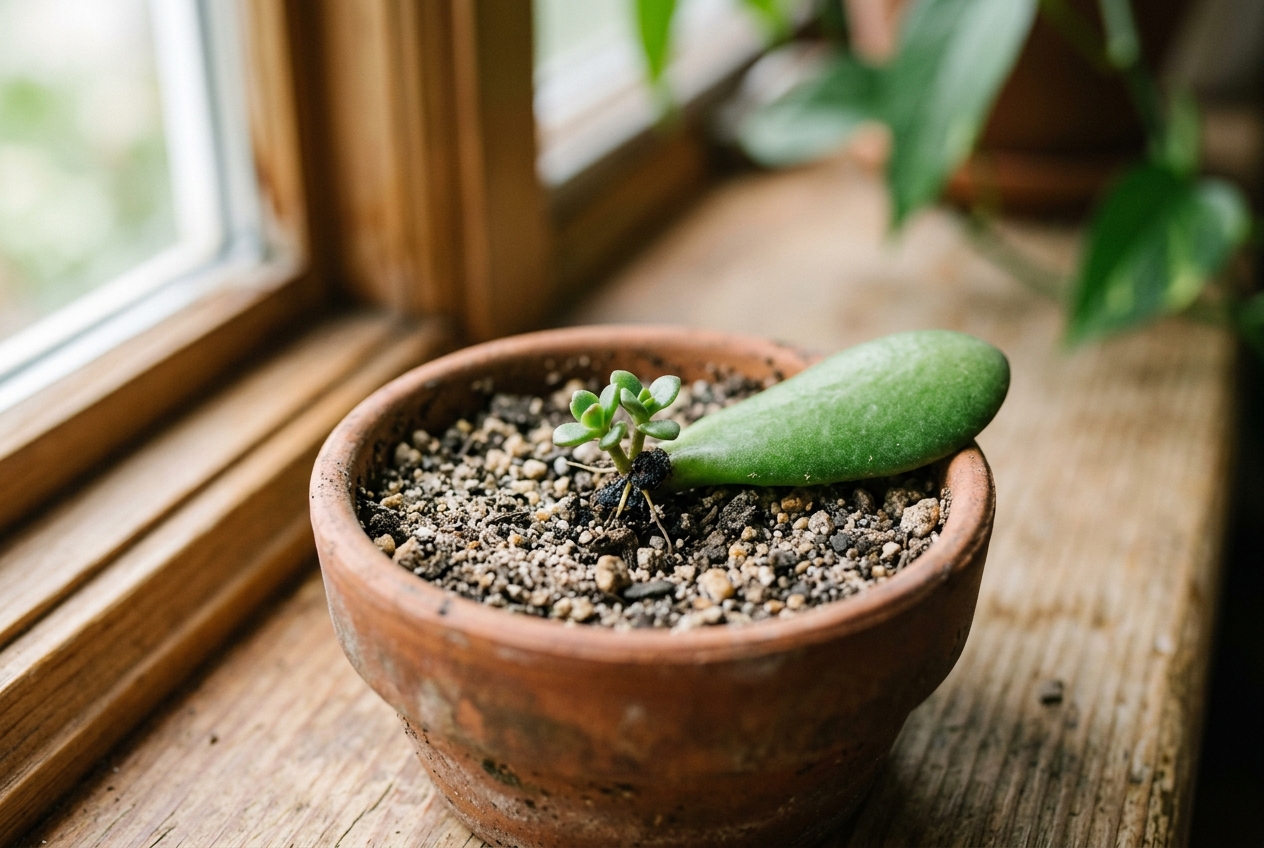
- Propagating Cuttings: Never throw away pruned stems. Let cut branches callus in the shade for 3 to 5 days, then insert into dry perlite or gritty soil. In 3 weeks, new roots will form effortlessly in jade plant care!
High-Drainage Mineral Substrates & Terracotta Stability
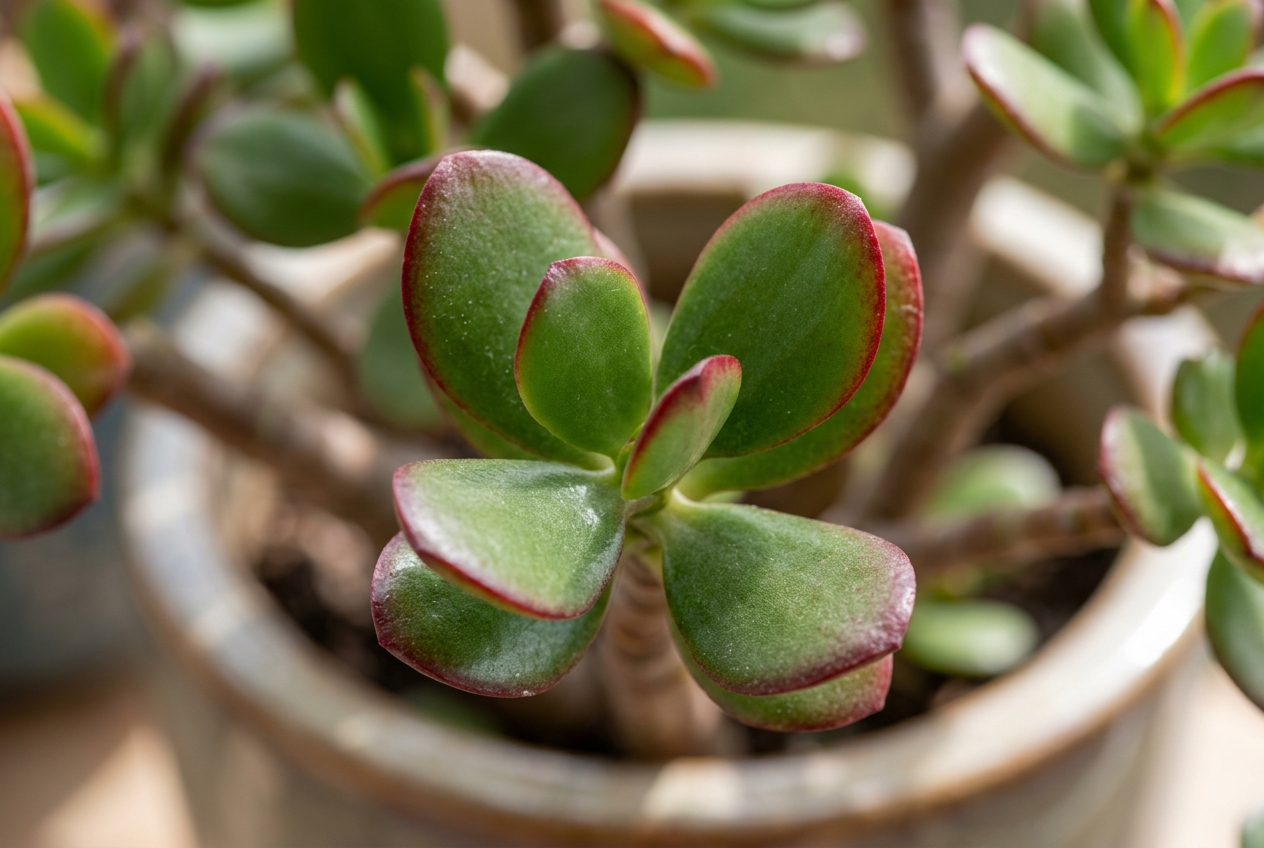
Dennis’s signature bonsai jade plant substrate formulation:
- 50% Coarse Horticultural Pumice / Lava Rock: Non-degrading structural aeration.
- 20% Coarse Quartz / Decomposed Granite: Heavy ballast that anchors the plant.
- 20% Organic Coco Coir / Peat: Base moisture and nutrient buffering.
- 10% Biochar & Worm Castings: Sustains natural biological health in jade plant care.
Photoperiod Triggers: Forcing Winter Star-Shaped Flower Clusters
To induce clusters of delicate pinkish-white star-shaped winter blooms in jade plant care:
- Summer Full Sun Exposure: Give the plant maximum outdoor sun or bright south-facing light all summer to store abundant carbohydrates.
- Autumn Night Cooling: In autumn, expose the plant to cool nighttime temperatures between 50°F and 55°F (10°C to 13°C) for 4 to 6 weeks in structured jade plant care.
- Complete Uninterrupted Darkness: Provide short-day photoperiods (12+ hours of complete darkness every night). By mid-winter, flower buds will burst across every branch tip!
- Pest Defense: Reference our Houseplant Pest Control Guide to prevent rare mealybug infestations in jade plant care.
Frequently Asked Questions (FAQ)
Why are leaves falling off my jade plant?
Sudden leaf drop is typically caused by severe overwatering and root rot, or moving the plant into sudden low-light conditions. Check root health, ensure the pot drains freely, and provide bright direct sunlight.
Why are the branches of my jade plant drooping and floppy?
Drooping, floppy branches indicate etiolation from inadequate light or dehydration. If leaves feel soft and flat, water deeply. If leaves feel plump but stems are weak, move to a south window and prune the branches back by half.
Is the jade plant toxic to cats and dogs?
Yes. Crassula ovata contains unidentified toxins that cause vomiting, lethargy, loss of muscle coordination, and decreased heart rate in dogs and cats. Keep containers out of reach of pets.
How do I get my jade plant to branch out?
Pinch or prune the terminal growing tip of any branch. The plant will stop growing straight and will activate two new lateral branches from the leaf node directly below the cut.
How long does a jade plant take to develop a thick trunk?
With aggressive annual pruning, maximum direct sunlight, and proper gritty soil, a jade plant will develop a 2-inch thick woody trunk in 3 to 5 years. Unpruned plants in low light can take 10+ years to achieve the same caliper.
Final Verdict & Dennis’s Annual Jade Plant Maintenance Guide
The jade plant is one of the most magnificent and durable heirloom succulents on earth. By mastering directional pruning, maximizing direct sunlight, using gritty mineral soil, and practicing disciplined watering, you will master jade plant care and cultivate a thick-trunked living masterpiece that can thrive for over a century.
Here is Dennis’s golden rule: Prune hard, provide blazing sunlight, and let the soil dry completely! Treat your jade plant with confidence, and it will reward you with a massive, woody tree trunk and lustrous jade foliage for generations to come!
Dennis P. Hansen
Dennis P. Hansen is a home gardener with a genuine passion for plants and the simple pleasure of growing them. He enjoys caring for houseplants, succulents, and other plants at home while continually learning from everyday gardening experiences. Dennis likes to share practical plant care tips, useful observations, and simple solutions that can help others grow healthier plants. He believes that caring for plants is a rewarding journey and that there is always something new to learn along the way.