
Care of Indoor Cyclamen Plants: 7 Ultimate Secrets


Mastering the care of indoor cyclamen plants is one of the most rewarding skills any houseplant enthusiast can develop. Cyclamen (Cyclamen persicum) light up winter windowsills with their extraordinary swept-back petals in shades of crimson, blush pink, white, and deep violet — yet they remain notoriously misunderstood. With the right approach to watering, temperature, light, and dormancy management, your cyclamen can bloom for up to five months and even be coaxed back to bloom year after year. In this comprehensive guide, you will find every single step you need to succeed.
- What Is a Cyclamen Plant?
- Light Requirements for Indoor Cyclamen
- Ideal Temperature and Humidity
- How to Water Cyclamen Plants Correctly
- Soil, Potting, and Fertilizing
- Deadheading and Grooming for Continuous Blooms
- Common Pests and Diseases
- Managing Cyclamen Dormancy: The Key to Reblooming
- When and How to Repot Cyclamen
- Is Cyclamen Toxic to Pets and Humans?
- Troubleshooting: Why Is My Cyclamen Dying?
- Frequently Asked Questions
The cyclamen’s reputation as a “difficult” plant is largely undeserved — it is simply misunderstood. Most cyclamen failures occur within the first three weeks of bringing a plant home, and the cause is almost always the same: warmth and overwatering. Unlike nearly every other popular flowering houseplant, cyclamen is a cool-season plant. It evolved in the rocky, well-drained hillsides of the Mediterranean — from Greece and Turkey through the Levant — where summers are hot and dry but winters are mild and moist. When you apply the care principles suited to a tropical houseplant, you essentially torture a Mediterranean woodland gem. Understanding its origins is the first — and perhaps most important — step in mastering cyclamen care.
There is also the mystery of the dormancy period that confounds first-time growers. Every spring, as temperatures rise and daylight increases, a cyclamen plant will naturally begin to decline: leaves turn yellow, stems collapse, and flowers disappear entirely. Most people conclude the plant has died and discard it. This is a tragic and completely avoidable mistake. What looks like death is in fact a strategic survival response — the tuber is going dormant, conserving energy underground through the heat of summer, ready to re-emerge and re-bloom come autumn. By understanding and respecting this cycle, you can keep a single cyclamen alive and flowering for a decade or more. Let us walk through every aspect of proper cyclamen care in precise, actionable detail.
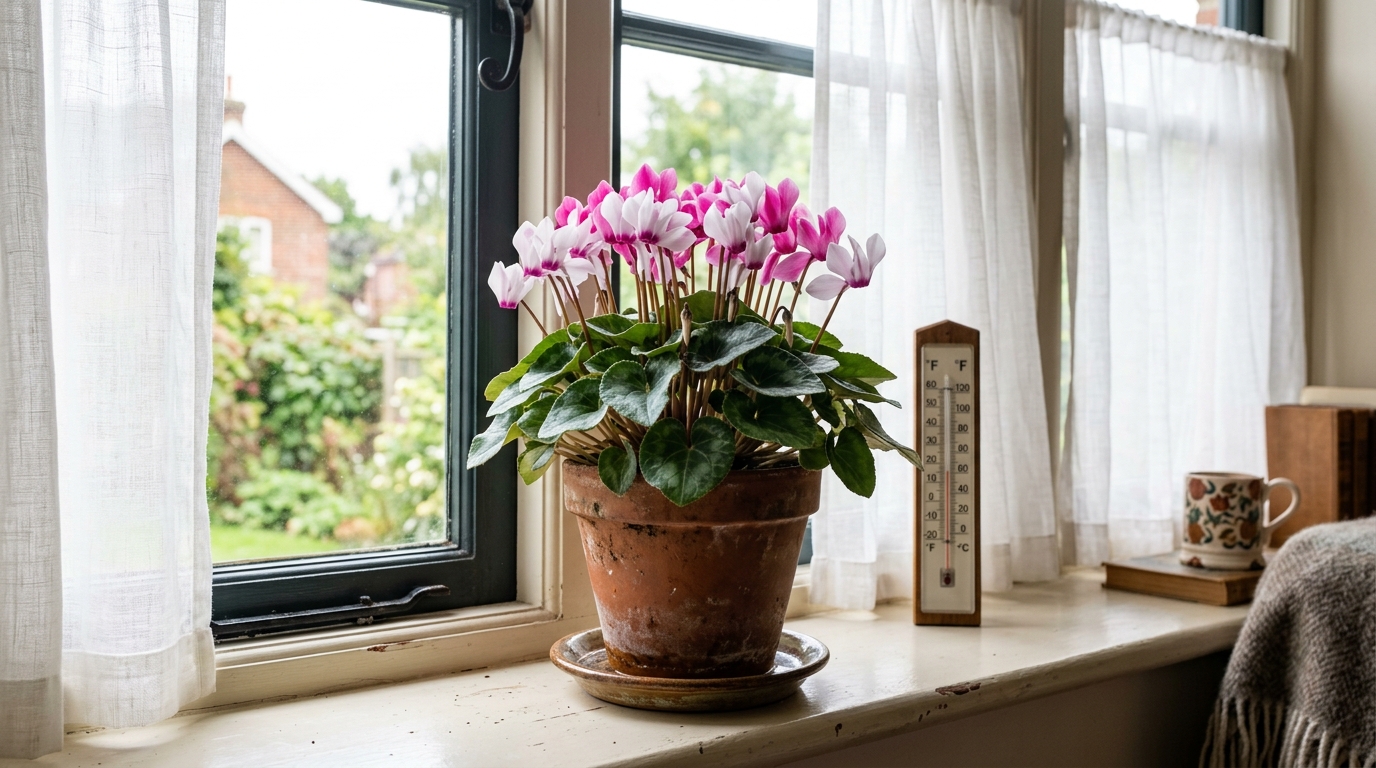
Table of Contents: Jump to Guide Section
- 1. What Is a Cyclamen Plant? A Brief Botanical Background
- 2. Light Requirements for Indoor Cyclamen: Finding the Sweet Spot
- 3. Ideal Temperature and Humidity for Indoor Cyclamen
- 4. How to Water Cyclamen Plants Correctly: The Bottom-Watering Method
- 5. Soil, Potting Mix, and Fertilizing Cyclamen
- 6. Deadheading and Grooming for Continuous Blooms
- 7. Common Pests and Diseases Affecting Indoor Cyclamen
- 8. Managing Cyclamen Dormancy: The Critical Skill for Reblooming
- 9. When and How to Repot Cyclamen
- 10. Is Cyclamen Toxic to Pets and Children?
- 11. Troubleshooting: Why Is My Cyclamen Dying? (7 Common Problems Solved)
- 12. Frequently Asked Questions About Care of Indoor Cyclamen Plants
- 13. Final Thoughts: Mastering the Care of Indoor Cyclamen Plants
What Is a Cyclamen Plant? A Brief Botanical Background
Cyclamen (Cyclamen persicum) belongs to the family Primulaceae and is native to the rocky alpine meadows and scrublands of the Mediterranean basin, particularly Turkey, Greece, Lebanon, and Israel. The plant grows from a flattened, disc-shaped tuber — sometimes called a corm — that can persist in the soil for decades when conditions are right. The name “cyclamen” is derived from the Greek word kyklos, meaning circle, a reference to the plant’s round tubers and the way the flower stalks coil downward after pollination to deposit seeds near the soil.
The species most commonly sold as a houseplant is Cyclamen persicum, which has been extensively hybridized over the past century to produce larger, more colorful flowers and a wider range of petal forms, including ruffled, fringed, and double-flowered varieties. These hybrids are typically sold in autumn and winter — exactly when the plant naturally blooms — and can be found in garden centers, supermarkets, and florists across North America and Europe. Their flowering season, which runs from October through March under ideal conditions, fills a valuable gap when few other flowering plants are at their peak.
It is worth distinguishing between the florist cyclamen (Cyclamen persicum) and the hardier, outdoor species such as Cyclamen hederifolium and Cyclamen coum. The outdoor species are extremely cold-hardy and are often grown in garden borders, but they are not the plants typically sold as indoor gift plants. The florist cyclamen is bred for large, dramatic blooms but requires specific indoor conditions to perform at its best. Understanding which type of cyclamen you own will help you calibrate your care approach correctly.
Light Requirements for Indoor Cyclamen: Finding the Sweet Spot
Light is one of the most critical — and most frequently mismanaged — aspects of the care of indoor cyclamen plants. Cyclamen needs bright, indirect light for a minimum of 6 hours per day during its growing and blooming season. This is not the same as full sun. Direct midday sunlight, particularly in a south-facing window in summer, will scorch the leaves, bleach the flowers, and stress the plant badly. The goal is bright ambient light without the intensity of direct sun rays falling on the foliage.
Best Window Positions for Cyclamen
- East-facing window: This is the single best location for a cyclamen indoors. East-facing windows receive gentle morning sunlight — bright but not harsh — which transitions into indirect light for the rest of the day. The morning sun also tends to keep temperatures slightly cooler than afternoon sun exposures.
- North-facing window: Acceptable in summer, but may be too dim in winter at higher latitudes. If your north window is your only option, supplement with a grow light positioned about 12 inches above the plant for 6–8 hours per day.
- West-facing window: Usable in autumn and winter, when the afternoon sun is lower and less intense. Place a sheer curtain between the glass and the plant to diffuse the light.
- South-facing window: Generally too bright and warm during the summer months, but can work in winter if you keep the plant well back from the glass and use a sheer diffusing curtain.
A key indicator that your cyclamen is getting too much direct sun: the leaves will develop pale, bleached patches or a faded, washed-out appearance, and the flowers will fade quickly. A sign of insufficient light: the plant will produce tall, leggy stems with widely spaced leaves and fewer, smaller flowers. The ideal plant in the right light position will be compact, with a dense rosette of leaves held close to the crown and an abundance of sturdy, upright flower stalks.
According to research published by the University of Maryland Extension, cyclamen performs best when given bright, diffused light in a room temperature no higher than 65°F (18°C). Their guidelines confirm that high light intensity combined with cool temperatures is the single most important factor for extending the blooming period of florist cyclamen.
Ideal Temperature and Humidity for Indoor Cyclamen
Temperature management is non-negotiable when it comes to the care of indoor cyclamen plants. Cyclamen is fundamentally a cool-weather plant, and the single most common reason for premature decline is keeping it in a room that is too warm. The ideal temperature range during the active growing and blooming season is 50°F to 65°F (10°C to 18°C). Night temperatures can safely drop to 40°F (4°C), which actually helps to intensify flower color and extend the blooming period significantly.
What Temperatures Will Harm Cyclamen
Temperatures consistently above 68°F (20°C) will cause cyclamen to enter early dormancy. The plant perceives warmth and increasing daylength as a signal that summer is approaching and will begin shutting down. Above 75°F (24°C), the damage accelerates: leaves yellow, flower buds fail to open, existing flowers drop prematurely, and the tuber may even rot if the soil is kept moist in warm conditions. Central heating is the number-one enemy of indoor cyclamen in winter homes. Keep the plant well away from radiators, heating vents, and appliances that generate heat.
Where to Place Your Cyclamen in a Heated Home
Finding a genuinely cool spot in a modern, centrally heated home can be a challenge, but there are several practical strategies. An unheated hallway or enclosed porch that stays cool but frost-free is ideal. A bedroom that you keep cooler than the main living areas is another excellent option — the plant will thank you for it. An east-facing windowsill in a room with the heating kept low overnight can also work very well, since window glass creates a cool microclimate even in a warm room.
Humidity Requirements
Cyclamen prefers moderate humidity levels — around 40% to 50% relative humidity. The dry air produced by central heating in winter can stress the plant and make it more susceptible to spider mite infestations. However, do not mist the foliage or flowers directly, as water sitting on the crown (the junction between the tuber and the stems) will cause crown rot, which is frequently fatal. Instead, boost humidity safely by:
- Placing the pot on a pebble tray filled with water (make sure the pot base sits above the waterline).
- Grouping your cyclamen near other houseplants, which collectively release moisture through transpiration.
- Using a cool-mist humidifier in the room, positioned to increase ambient humidity without spraying directly on the plant.
How to Water Cyclamen Plants Correctly: The Bottom-Watering Method
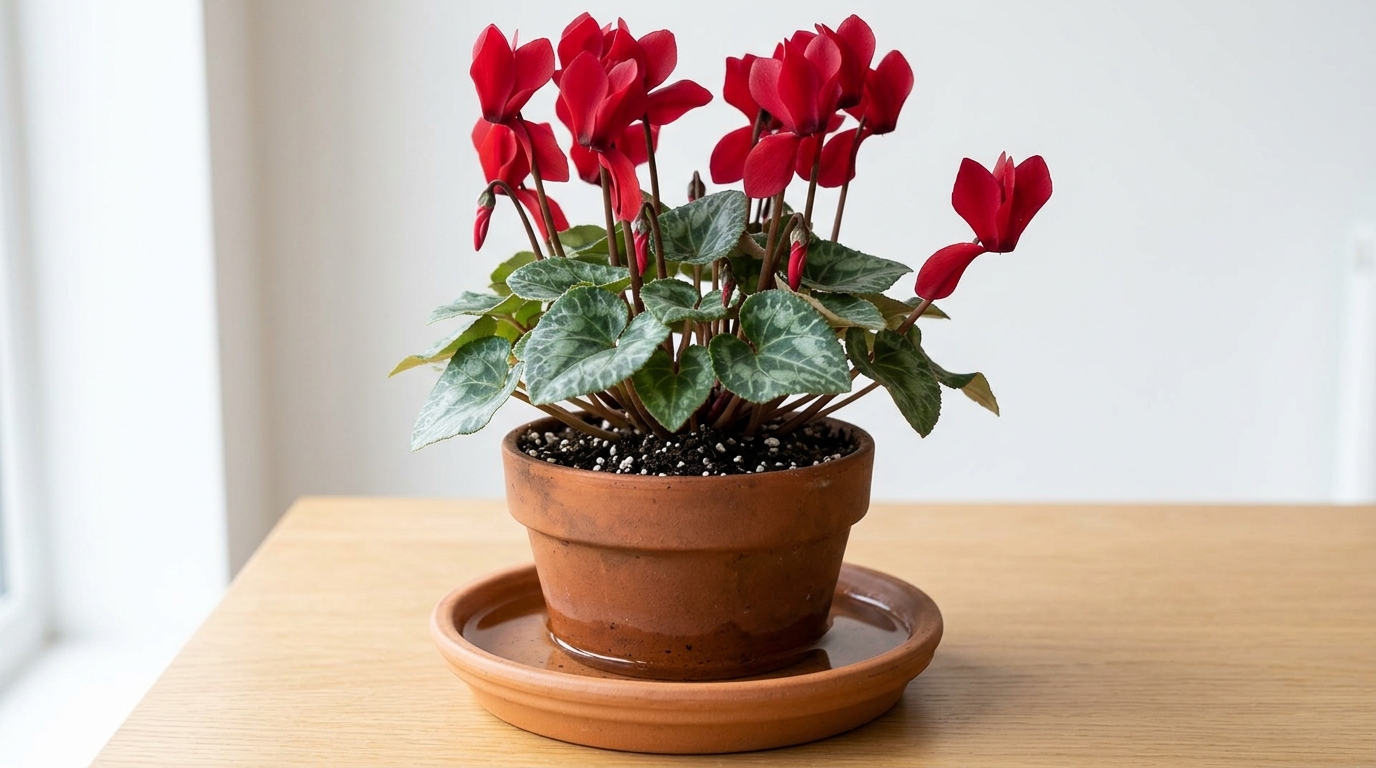
Watering is the area where most cyclamen owners go wrong, and mastering it is central to the care of indoor cyclamen plants. The core principle is simple but counterintuitive compared to most houseplants: keep the soil consistently moist but never waterlogged, and never allow water to sit on the crown or foliage. The reason for this specific approach comes down to the anatomy of the plant. The crown of the cyclamen — the flat, disc-like top of the tuber from which all the leaves and flowers emerge — is extremely susceptible to rot if it stays wet. Even a small amount of water pooling at the crown can trigger fungal infection within 48 hours in a warm room.
Step-by-Step Bottom-Watering Guide
- Check soil moisture first: Before watering, insert your finger about an inch into the soil. The soil should feel dry to the touch at the surface but slightly cool and barely moist an inch down. If the soil feels wet or cool, wait another day or two.
- Fill a saucer or basin: Pour room-temperature water into a shallow saucer or basin deep enough to submerge the bottom quarter of the pot. Use tepid or cool water — cold water from the tap can shock the roots, and hot water will stress the plant.
- Place the pot in the water: Set the pot in the water and allow the soil to absorb moisture through the drainage holes. This process typically takes 20–30 minutes.
- Check for thorough absorption: When the top surface of the soil feels slightly moist, the watering is complete. You can test this by pressing your fingertip gently to the surface.
- Remove and drain: Lift the pot out of the saucer and allow any excess water to drain freely for 5–10 minutes before returning it to its saucer or decorative cache pot. Never allow the pot to sit in standing water longer than 30–45 minutes, as this saturates the soil and deprives roots of oxygen.
Watering Frequency
During the active blooming season (autumn through spring), most cyclamen plants will need watering every 5–7 days, depending on pot size, room temperature, and humidity. Smaller pots in warm, dry rooms may need watering every 3–4 days. Larger pots in cool, humid spaces may go 10 days between waterings. The key is to observe the plant rather than follow a rigid schedule. A cyclamen that needs water will show very slight wilting — the leaves will appear marginally less turgid and the flower stalks will droop slightly. Do not wait until the plant is severely wilted before watering, as this stresses the plant significantly.
If you are looking for guidance on watering other demanding houseplants, our article on Peace Lily Care Indoors covers the similarly moisture-sensitive requirements of Spathiphyllum, another popular flowering houseplant that shares cyclamen’s intolerance of both drought and waterlogging.
Soil, Potting Mix, and Fertilizing Cyclamen
The right soil is foundational to the care of indoor cyclamen plants. Cyclamen requires a well-draining, slightly acidic potting mix with a pH of approximately 6.0 to 6.5. The mix must retain enough moisture to keep the roots hydrated between waterings, yet drain freely enough that the root zone never becomes waterlogged. A standard peat-based potting mix works adequately but benefits significantly from the addition of drainage-improving amendments.
Recommended Potting Mix Recipe
- 2 parts peat moss or coco coir (for moisture retention and acidity)
- 1 part perlite (for drainage and aeration)
- 1 part coarse horticultural sand (for additional drainage)
Alternatively, a commercially available orchid potting mix blended 50/50 with standard potting compost creates an excellent growing medium for cyclamen. The chunky texture of orchid bark provides the drainage that cyclamen roots demand.
Fertilizing During the Growing Season
Cyclamen has moderate fertilizer requirements. During the blooming season, feed with a low-nitrogen, high-potassium liquid fertilizer every 3–4 weeks. A formula such as a tomato fertilizer (which is naturally high in potassium and phosphorus) works exceptionally well. The high potassium content promotes flower production and color intensity, while keeping nitrogen low prevents the plant from putting excessive energy into lush leaf growth at the expense of blooms.
Do not fertilize a newly purchased cyclamen for the first 4–6 weeks. Nurseries typically pre-load their plants with slow-release fertilizer before sale, and adding more immediately can cause fertilizer burn on the sensitive root system. A telltale sign of over-fertilization is the browning of leaf tips and margins, combined with a reluctance to produce new flower buds.
Stop fertilizing entirely as the plant approaches dormancy in late spring. Once the leaves begin to yellow and stems start to collapse, the plant is signaling that it is shutting down for the season, and additional nutrients at this point will simply accumulate as salts in the soil without being absorbed.
For context on how cyclamen’s fertilizer needs differ from other popular indoor bloomers, our detailed guide on Snake Plant Care Guide explores how low-nutrient requirements actually help certain houseplants thrive — a fascinating contrast to cyclamen’s seasonal feeding schedule.
Deadheading and Grooming for Continuous Blooms
One of the most overlooked yet impactful aspects of the care of indoor cyclamen plants is proper deadheading — the removal of spent flowers and dying leaves. Unlike many plants where deadheading is optional, for cyclamen it is genuinely essential for maintaining a long, productive bloom period. Here’s why: when a cyclamen flower is allowed to set seed, the plant diverts significant energy toward seed development, which dramatically reduces the number of new flower buds that the plant will produce. By removing spent blooms promptly and correctly, you redirect all of the plant’s energy toward producing more flowers.
How to Deadhead Cyclamen Correctly
This is where many growers make a critical mistake: cutting the spent flower stalk with scissors. The problem with cutting is that it leaves a stub of stem attached to the tuber. This stub can become an entry point for fungal pathogens and bacteria, particularly in the moist conditions that the crown of the cyclamen inhabits. The correct technique is to twist and pull the spent flower stalk away from the tuber rather than cutting it.
- Grasp the base of the spent flower stalk as close to the tuber as possible.
- With a gentle but firm motion, twist the stalk a quarter turn while simultaneously pulling it upward and outward.
- The entire stalk, including the point where it attaches to the tuber, should come away cleanly in one piece.
- Discard the removed stem and flower — do not compost cyclamen material if you suspect any fungal issues.
Apply the same twist-and-pull technique to any yellowing or dead leaves. Remove them as soon as they show significant yellowing to prevent them from becoming a harbor for botrytis (gray mold), which is a common and serious problem for cyclamen grown in cool, slightly damp conditions.
Common Pests and Diseases Affecting Indoor Cyclamen
Even with excellent care, cyclamen can fall victim to a handful of common pests and diseases. Knowing what to look for — and how to respond immediately — can mean the difference between saving a plant and losing it.
Spider Mites (Tetranychus urticae)
Spider mites are the most frequent pest problem for indoor cyclamen, particularly in heated homes with low humidity during winter. These tiny arachnids (barely visible to the naked eye) colonize the undersides of leaves, feeding on plant sap and leaving behind a distinctive fine webbing. Early infestation symptoms include pale, stippled, or silvery patches on the upper leaf surfaces. A severe infestation will cause leaves to curl, yellow, and drop prematurely.
Treatment: Isolate the affected plant immediately to prevent spread. Wipe down all leaves with a damp cloth to physically remove mites and eggs. Apply insecticidal soap spray to both sides of all leaves, repeating every 5–7 days for three to four treatment cycles. Neem oil spray is also effective. Increasing ambient humidity is an important preventative measure, as spider mites struggle to reproduce in humid environments.
Cyclamen Mites (Phytonemus pallidus)
Cyclamen mites are a more serious threat than spider mites and are difficult to spot without a magnifying glass. They target new growth, causing leaves to become distorted, puckered, and stunted. Flower buds may fail to open or open in a distorted, discolored form. Unlike spider mites, cyclamen mites do not produce visible webbing, making early detection challenging.
Treatment: Remove and destroy all severely distorted growth. Apply a miticide specifically labeled for cyclamen mites. In many cases, severe infestations are difficult to fully eradicate, and the safest course of action is to destroy the plant and start fresh to prevent spread to other houseplants.
Botrytis (Gray Mold)
Botrytis cinerea, or gray mold, is a fungal disease that thrives in the cool, slightly humid conditions that cyclamen enjoys. It manifests as a fuzzy gray coating on stems, leaves, and flowers, typically beginning on dead or dying tissue before spreading to healthy parts of the plant. Botrytis is favored by poor air circulation and water remaining on foliage or at the crown.
Treatment: Remove all affected plant material immediately, cutting or pulling well below the visible infection. Ensure the plant has good air circulation and that water is never allowed to stand on the crown, leaves, or flower petals. Apply a copper-based fungicide as a preventative measure if botrytis has been problematic in previous seasons.
Root Rot (Pythium and Phytophthora species)
Root rot is almost always caused by overwatering or inadequate drainage. Symptoms include sudden, dramatic wilting that does not respond to watering, yellowing of multiple leaves simultaneously, and a foul, musty odor from the potting mix. If you gently unpot the plant and examine the roots, infected roots will appear dark brown to black and feel soft and mushy rather than firm and white.
Treatment: Remove all infected roots with sterile scissors. Repot into fresh, well-draining potting mix in a clean pot with adequate drainage holes. Allow the root system to dry slightly before watering, and commit to a much more cautious watering schedule going forward.

Managing Cyclamen Dormancy: The Most Critical Skill for Reblooming
The dormancy cycle is the single most important — and most frequently misunderstood — aspect of the care of indoor cyclamen plants. Every year, as spring temperatures rise above 65°F (18°C) and daylength increases, your cyclamen will begin to shut down. This is not a problem. This is not a disease. This is the plant’s genetically programmed survival response, and your job is to honor it rather than fight it.
Recognizing the Start of Dormancy
Dormancy signals typically begin between March and May, depending on your climate and the temperature of your home. Signs include:
- Flowers stop being produced and existing blooms fade more quickly than usual.
- Leaves begin to turn yellow, starting from the outer edges and working inward.
- Stems become increasingly limp and collapse toward the soil surface.
- The plant looks, for all intents and purposes, like it is dying.
Step-by-Step Dormancy Management Protocol
- Stop watering gradually: As leaves begin to yellow, reduce watering frequency dramatically. The goal is to allow the soil to dry out almost completely over a 4–6 week period, encouraging the plant to naturally wind down and direct its remaining energy into the tuber.
- Stop fertilizing completely: No more fertilizer from the point dormancy signals are visible.
- Move to a cool, dark location: Once all the leaves and stems have died back completely, move the pot — with the tuber still in the soil — to a cool, dark, dry location. An unheated garage, shed, basement, or cool cupboard works perfectly. The ideal storage temperature is 50°F to 60°F (10°C to 15°C). Do not refrigerate the plant.
- Minimal water during dormancy: Leave the pot almost entirely dry for 8–10 weeks. Some growers give a tiny amount of water (just enough to prevent the tuber from completely desiccating) once a month during this period.
- Repot in late summer: In late August or early September — approximately 8–10 weeks after moving the plant to its dark location — repot the tuber into fresh potting mix. The tuber should be planted so that the top third is above the soil surface (unlike most bulbs, cyclamen tubers should never be fully buried). Choose a pot that is only 1–2 inches larger in diameter than the tuber itself; cyclamen blooms best when slightly root-bound.
- Resume normal care: Return the repotted plant to its bright, cool windowsill. Begin watering lightly — the soil should barely be moist at first. Within 4–6 weeks, you should begin to see new leaves emerging from the crown, signaling the start of a new growing season. Resume regular watering and begin fertilizing once the plant has a good canopy of 6–8 mature leaves.
According to the Clemson University Home & Garden Information Center, proper dormancy management is the key to maintaining cyclamen as a long-lived perennial houseplant rather than treating it as a single-season annual. Their horticultural research confirms that cyclamen tubers stored correctly during dormancy can reliably re-bloom for 10 years or more.
When and How to Repot Cyclamen
Repotting is best done once per year, during the late dormancy period (late summer), before the new growing season begins. Cyclamen performs best when slightly root-bound — the roots filling the pot creates a kind of productive stress that encourages flowering. Avoid the temptation to move the plant into an oversized pot, as excess soil around the roots will retain moisture that the plant does not need, dramatically increasing the risk of root rot.
Step-by-Step Repotting Guide
- Gently remove the dormant tuber from its old pot and shake off the old potting mix from the roots.
- Inspect the tuber carefully. A healthy tuber is firm, heavy, and pale brown. Soft, discolored, or foul-smelling areas indicate rot — cut these away with a sterilized knife and dust the wounds with powdered sulfur or activated charcoal before repotting.
- Choose a clean pot with excellent drainage holes. The pot should be 1–2 inches wider in diameter than the tuber itself.
- Fill the pot to a depth that, when the tuber is placed inside, the top one-third of the tuber sits above the pot rim level. This ensures the tuber will be positioned correctly — with its upper third exposed above the soil surface — once you fill in around it.
- Place the tuber in the center of the pot and fill around it with fresh potting mix, firming it gently.
- Water lightly — just enough to settle the soil — and place in a cool, bright location to begin the new growing cycle.
Is Cyclamen Toxic to Pets and Children?
This is an important consideration for any household. According to the ASPCA Animal Poison Control Center, cyclamen is toxic to dogs, cats, and horses. The plant contains saponins, which are concentrated primarily in the tubers but present throughout all parts of the plant. Ingestion of small amounts of leaf or petal material can cause drooling, vomiting, and diarrhea. Ingestion of larger amounts — particularly of the tuber itself — can cause more serious symptoms including heart rhythm abnormalities, seizures, and in severe cases, death.
For households with pets or young children who might chew on plants, cyclamen should be placed out of reach or substituted with a non-toxic flowering alternative. Keep cyclamen on high shelves, in enclosed plant stands, or in rooms that pets and small children do not have access to. If you suspect your pet has ingested any part of a cyclamen plant, contact your veterinarian or the ASPCA Animal Poison Control Center (888-426-4435) immediately.
Troubleshooting: Why Is My Cyclamen Dying? (7 Common Problems Solved)
Even with the best intentions, problems can arise. Here is a direct, solution-focused guide to the most common cyclamen care failures.
Problem 1: Yellowing Leaves
Most likely cause: Overwatering or excessively high temperatures. Check the soil moisture — if it feels wet and heavy, allow the plant to dry out significantly before the next watering. Also check room temperature; if it is consistently above 68°F (20°C), move the plant to a cooler location.
Problem 2: Flower Buds Failing to Open
Most likely cause: Room too warm, or insufficient light. Move to a cooler, brighter east-facing windowsill. Buds that are caught in a “tight fist” stage for more than a week without opening are typically responding to inadequate light combined with excess heat.
Problem 3: Wilting Despite Moist Soil
Most likely cause: Root rot. Unpot the plant immediately and examine the roots. If they are brown and mushy, treat for root rot as described in the pests and diseases section above. Wilting despite moist soil is the classic symptom of roots that have been destroyed by rot and can no longer absorb water — a deadly paradox that must be addressed urgently.
Problem 4: Leggy, Sparse Foliage
Most likely cause: Insufficient light. Relocate to a brighter position or supplement with a grow light. Cyclamen in insufficient light will stretch toward the light source, producing long, weak stems and fewer flowers.
Problem 5: Brown Leaf Tips and Edges
Most likely cause: Low humidity, exposure to cold drafts, or over-fertilization. Check for drafts near the plant’s current position. Increase ambient humidity using the pebble tray method. If you have been fertilizing more than once a month, reduce frequency and flush the soil with a generous watering to leach out excess fertilizer salts.
Problem 6: Plant Suddenly Collapses in Spring
Most likely cause: Natural dormancy onset. This is normal and expected. Do not water heavily in an attempt to “revive” the plant. Instead, follow the dormancy management protocol described above. What looks like sudden death is the tuber preparing for its summer rest period.
Problem 7: No New Blooms After Dormancy
Most likely cause: The plant was stored too warm during dormancy, or was not given adequate cool growing conditions after waking. Ensure that post-dormancy temperatures stay below 65°F (18°C) and provide maximum available indirect light. Patience is essential — it can take 6–8 weeks from the appearance of the first new leaves before the first flower buds begin to emerge.
If you enjoy troubleshooting houseplant problems, our in-depth article on Pothos Care Guide covers the diagnostic approach to common foliage plant issues in similar practical detail — a great resource for building your overall plant care skills.
Frequently Asked Questions About Care of Indoor Cyclamen Plants
How long do cyclamen plants live indoors?
With proper dormancy management, a cyclamen tuber can live and re-bloom for 10 to 20 years or more. The world record for a continuously blooming cyclamen tuber in cultivation is reported to exceed 100 years, though this is exceptional. Realistically, a well-cared-for cyclamen will provide 5–10 years of reliable annual blooming when its dormancy cycle is properly respected.
Why are my cyclamen leaves turning yellow?
Yellow leaves on an actively growing cyclamen most commonly indicate overwatering, excessive room temperature, or natural leaf senescence (old leaves at the base simply dying off as new ones emerge). In spring, yellowing across the entire plant is the normal onset of dormancy. Check watering frequency and room temperature first; if both are appropriate and yellowing is isolated to a few older outer leaves, this is simply natural leaf turnover and is not a cause for concern.
Can I keep cyclamen outdoors in summer?
In mild climates with summer temperatures below 75°F (24°C) and low humidity, a dormant cyclamen tuber in its pot can be kept in a sheltered, dry, shaded location outdoors during summer. In hot, humid climates, it is safer to store the dormant tuber indoors in a cool, dry, dark location. The key risk of outdoor summer storage is exposure to excessive moisture from rain, which can rot a dormant tuber surprisingly quickly.
How do I know if my cyclamen tuber is alive during dormancy?
A living tuber is firm and heavy. Gently press the tuber with your thumb — it should feel like a firm apple, not like a soft, mushy fruit. A slight amount of surface wrinkling is acceptable during dormancy. If the tuber feels hollow, completely desiccated, or has areas of soft, discolored tissue, it may have died or suffered rot damage.
Should I deadhead cyclamen?
Yes, absolutely — and using the correct twist-and-pull technique rather than cutting. Prompt deadheading of spent flowers and yellowing leaves is one of the most effective ways to extend the blooming period and prevent fungal disease. Check the plant every 3–4 days during peak bloom and remove any declining flowers and leaves immediately.
Can cyclamen grow in low light?
No. Cyclamen requires bright, indirect light to bloom reliably. It will survive in low light for short periods but will produce few or no flowers, and the foliage will become pale and leggy. If your natural light conditions are poor, a dedicated grow light provides an effective solution. Use a full-spectrum LED grow light positioned 10–12 inches above the plant for 12–14 hours per day.
Final Thoughts: Mastering the Care of Indoor Cyclamen Plants
The care of indoor cyclamen plants rewards patience, observation, and a willingness to give this extraordinary plant the cool, bright, carefully watered environment it truly needs. Cyclamen is not a difficult plant — it simply requires different care than most other houseplants. By respecting its Mediterranean origins, keeping temperatures cool, watering from below, removing spent blooms promptly, and honoring the dormancy cycle each summer, you will be rewarded with one of the most spectacular floral displays available to the indoor gardener. The swept-back petals in their jewel-like colors, hovering above their beautifully marbled leaves from October through March, make every bit of the effort thoroughly worthwhile.
As the Royal Horticultural Society notes in their Cyclamen Growing Guide, this plant has been grown in British homes since the Victorian era precisely because it offers the gardener something no other plant can: vibrant, cheerful blooms at the coldest, darkest time of year. With the knowledge you now have, there is every reason to believe that your cyclamen will deliver that same winter magic for many years to come.
Dennis P. Hansen
Dennis P. Hansen is a home gardener with a genuine passion for plants and the simple pleasure of growing them. He enjoys caring for houseplants, succulents, and other plants at home while continually learning from everyday gardening experiences. Dennis likes to share practical plant care tips, useful observations, and simple solutions that can help others grow healthier plants. He believes that caring for plants is a rewarding journey and that there is always something new to learn along the way.