
Monstera Houseplant: 7 Proven Secrets for Thriving Foliage

Few architectural greenery choices command an interior space quite like a vigorous, glossy monstera houseplant. Over years of cultivating tropical aroids on sunlit windowsills and open living room floors, I, Dennis P. Hansen, have learned that these Central American beauties thrive when indoor care respects their wild climbing biology. In this master horticultural guide, we unpack the cellular science of fenestrations, root oxygenation, chunky aroid substrate formulating, vertical support mechanics, and seasonal rhythms necessary to keep your botanical statement specimen flourishing for decades.
Table of Contents
- Botanical Fundamentals and Cellular Dynamics of monstera houseplant
- Comprehensive Care Guide: Light, Irrigation, Substrate, and Microclimates
- Culture and Environmental Management Matrix
- Dennis’s Advanced Diagnostic Troubleshooting: 7 Critical Solutions
- Seasonal Adjustments: Spring Through Winter Cycles
- Master FAQ: In-Depth Expert Answers on monstera houseplant
- Authoritative Horticultural References
Botanical Fundamentals and Cellular Dynamics of monstera houseplant
To cultivate a showstopping monstera houseplant with long-term success, indoor growers must look beyond decorative aesthetics and understand the evolutionary biology governing aroid physiology. Botanically identified as Monstera deliciosa, this iconic member of the family Araceae originates in the humid, tropical understories and river valleys extending from southern Mexico through Panama. In native rainforest canopies, monsteras are not terrestrial floor plants; they germinate on the forest floor as skototropic vines—actively growing toward darkness to locate massive tree trunks—before transitioning into aggressive hemiepiphytic climbers that scale ancient host trees toward the ambient canopy light.
The signature morphological hallmark of the monstera houseplant is leaf fenestration—the dramatic slits and perforated holes that develop along mature leaf blades. Fenestration is not an ornamental accident; it is a sophisticated aerodynamic and photosynthetic adaptation. In hurricane-prone tropical ecosystems, perforated leaf blades allow violent gusts of wind to pass through the canopy without tearing expansive petioles from host trees. Furthermore, fenestrations permit dappled sunlight filtering through upper forest layers to penetrate downward to lower juvenile foliage, maximizing overall carbon fixation across the entire vine structure without demanding excess metabolic leaf mass.
Another vital botanical structure is the aerial root network. Emerging from nodes along the central climbing vine, thick adventitious aerial roots serve two distinct physiological functions. Upper aerial roots act as mechanical anchors, secreting adhesive lignin and pectin compounds that bind tightly into the fissures of tree bark or moss poles. Simultaneously, lower aerial roots extend downward through ambient air until they penetrate forest leaf litter, transforming into subterranean feeder roots equipped with fine root hairs that absorb dissolved mineral ions and moisture. When growing a monstera houseplant indoors, guiding these aerial roots down into the substrate exponentially enhances transpirational pull and nutrient delivery into expanding leaf blades.
According to botanical research from the University of Florida IFAS Extension Plant Directory, understanding aroid root respiration is the single most important factor in container longevity. Monsteras produce thick, fleshy roots that require continuous gas exchange. In saturated, compacted container potting soils, stagnant water displaces oxygen from substrate micropores, inducing root-zone hypoxia. Without oxygen, cellular respiration halts, root hair membranes collapse, and soilborne fungal pathogens like Pythium and Phytophthora destroy the vascular system, resulting in yellow chlorotic leaves and limp petioles.

Furthermore, managing photomorphogenesis—the light-driven regulation of plant architecture—is essential for indoor monsteras. In insufficient light, the plant produces elongated, weak petioles in an attempt to reach distant light sources, while new leaves emerge solid and unperforated. By supplying bright, indirect light that meets the plant’s light saturation threshold, you maintain stocky, upright stems and stimulate the cellular signaling required for bold, multi-tiered fenestrations.
Comprehensive Care Guide: Light, Irrigation, Substrate, and Microclimates
Every indoor monstera thrives when its cultural environment mimics the warm, dappled canopy conditions of its native habitat. Sustaining vibrant green leaves and rapid vertical growth requires careful balancing of irradiance, substrate hydrology, atmospheric vapor pressure deficit, and nutrient supply. Here are the core cultural parameters for maintaining vigorous monstera houseplants indoors:
1. Irradiance and Photosynthetic Photon Flux Density
Light provides the biochemical fuel that powers vegetative growth, water uptake, and leaf perforation. While commercial plant tags often label the monstera houseplant as tolerant of low light, this claim refers merely to short-term survival. Kept in dim corners, a monstera slowly declines: internodes stretch excessively, foliage pales, and emerging leaf blades remain small and completely unperforated.
For rapid leaf sizing and deep fenestrations, provide bright, indirect daylight measuring between 200 and 400 foot-candles (roughly 2,000 to 4,000 lux) for six to eight hours daily. An unobstructed east-facing window delivers gentle morning photons that power photosynthesis without thermal leaf burn. Unshaded south- or west-facing windows offer strong light, but direct afternoon rays shining through double-pane glass can break down chlorophyll pigments, causing bleached white or yellow heat lesions. Position containers three to five feet back from harsh exposures or hang sheer linen curtains to scatter the rays. Consult the North Carolina State Extension Plant Toolbox on Monstera Deliciosa for detailed guidance on light balancing and environmental acclimation.
2. The Biophysics of Container Irrigation: The Drench-and-Dry Method
Irrigation mistakes cause the majority of indoor aroid issues. Sticking to a rigid weekly watering schedule ignores fluctuating room temperatures, seasonal daylight shifts, and pot materials. Dennis Hansen champions the biophysical drench-and-dry protocol.
Allow the top two to three inches of potting mix to dry out before watering again. Test moisture depth by inserting an unvarnished wooden skewer or digital moisture meter into the center of the root mass; if the skewer emerges clean and dry from the upper root zone while the lower root core feels slightly cool and damp, it is time to irrigate. Apply lukewarm, room-temperature water evenly across the entire soil surface until ten to twenty percent drains freely from the bottom drainage holes. This thorough soaking flushes out accumulated fertilizer salts and pulls fresh atmospheric oxygen into the root zone as water drains. Always discard standing runoff from drainage saucers after twenty minutes. If lower leaves begin yellowing, consult our diagnostic protocol on Why Are My Plant Leaves Turning Yellow: 7 Proven Fixes.
For large specimens in hefty containers where topsoil may compact under overhead watering, explore our tested guide on bottom watering indoor plants for a reliable technique that saturates the root zone uniformly without disturbing surface roots.
3. Substrate Engineering: Formulating the Chunky Aroid Mix
Standard bagged houseplant soil composed predominantly of fine peat moss compacts rapidly after repeated waterings, creating an anaerobic barrier around root hairs. High-performing substrate for a monstera houseplant requires an open structure that delivers thirty to forty percent air-filled porosity while preserving steady moisture retention.
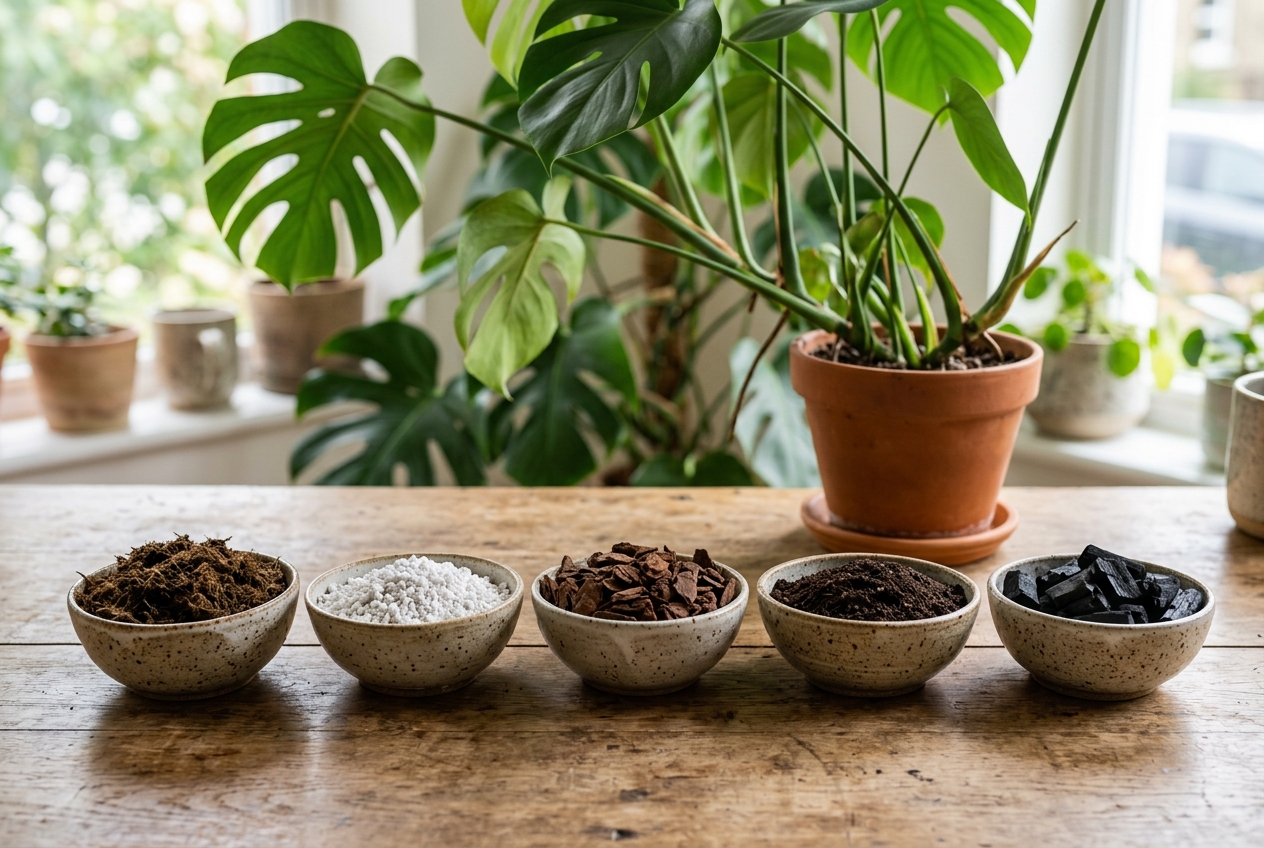
Dennis recommends formulating a coarse DIY aroid mix: combine thirty percent quality potting soil or coco coir, thirty percent coarse horticultural orchid bark (fir or pine), twenty percent coarse perlite or pumice, ten percent horticultural charcoal, and ten percent nutrient-dense worm castings. The orchid bark and pumice create stable structural macropores that resist compaction and let excess water drain immediately. Meanwhile, the coco coir and worm castings provide high cation exchange capacity (CEC), electrically holding onto essential nutrients—including potassium, calcium, and magnesium—until root hairs absorb them. Explore substrate optimization in our detailed guide on creating a balanced houseplant soil mix.

4. Ambient Temperature and Vapor Pressure Deficit (VPD)
Tropical monsteras operate at peak metabolic efficiency within a temperature range of 65°F to 85°F (18°C to 29°C). Sustained exposure to temperatures below 55°F (13°C) halts vegetative cell division, and sub-45°F (7°C) chills rupture cell membranes, leading to blackened, water-soaked foliage. Keep containers away from drafty exterior entryways, uninsulated window glass, or air conditioning vents.
Equally critical is vapor pressure deficit (VPD)—the difference between the water vapor pressure inside the leaf and that of the surrounding room air. In winter, heated living spaces often see relative humidity plummet below thirty percent. High VPD accelerates foliar transpiration beyond what roots can supply, causing delicate leaf margins to curl, brown, and turn crispy. Running an ultrasonic cool-mist humidifier to maintain relative humidity between 55% and 65% stabilizes VPD, keeps leaf cuticle layers supple, promotes smooth leaf unfurling, and prevents edge necrosis.
5. Balanced Fertilization, Vertical Training, and Moss Pole Mechanics
Because potted monsteras grow rapidly over a single season, soil nutrients are steadily depleted. During active spring and summer growth, feed your monstera monthly with a balanced liquid fertilizer formulated at an N-P-K ratio such as 3-1-2 or 20-20-20, diluted to one-half of the manufacturer’s recommended strength. Nitrogen fuels leaf expansion, phosphorus supports root development, and potassium reinforces cell wall rigidity. Always apply fertilizer solution to pre-moistened soil to prevent root burn, and halt all feeding from October through early March.
Because Monstera deliciosa is a natural climber, vertical training on a sphagnum moss pole, coir totem, or cedar plank is vital. In nature, vertical climbing triggers hormonal responses that cue the plant to produce larger leaves and multi-tiered fenestrations. Secure the thick central vine to the support pole using soft plant ties, leaving the flexible leaf petioles free to pivot toward ambient light. Keep the moss pole damp to encourage aerial roots to anchor into the pole, creating a secondary vascular conduit for moisture and nutrients.

Culture and Environmental Management Matrix
To assist indoor growers in fine-tuning environmental parameters for a monstera houseplant, Dennis Hansen has compiled this structured cultural reference matrix outlining target benchmarks and practical interventions:
| Care Parameter | Optimal Target Range | Dennis’s Essential Grower Guidance |
|---|---|---|
| Light Intensity | Bright, indirect sunlight (200–400 Foot-Candles / 2,000–4,000 Lux) | East exposure is ideal; shield south/west glass with sheer curtains; rotate container 90 degrees bi-weekly. |
| Irrigation Rhythm | Top 2–3 inches dry before watering; drench thoroughly | Always discard standing saucer drainage after 20 minutes to prevent perched water tables and root rot. |
| Substrate Mix | Chunky aroid blend (pH 5.5–6.5) | Blend 30% bark, 20% perlite, 10% charcoal, and 10% worm castings to guarantee 35% air-filled porosity. |
| Temperature Window | 65°F to 85°F (18°C to 29°C) | Protect foliage from drafty exterior entryways, air conditioning vents, and sudden winter cold snaps below 55°F. |
| Relative Humidity | 55% to 65% Ambient Humidity | Run an ultrasonic cool-mist humidifier during winter heating to prevent leaf tears and crispy brown margins. |
| Nutrient Delivery | Balanced liquid fertilizer (3-1-2 or 20-20-20 N-P-K) at 1/2 strength | Apply monthly during active growth from April to August; suspend completely during autumn and dark winter months. |
Dennis’s Advanced Diagnostic Troubleshooting: 7 Critical Solutions
When container microclimates drift away from tropical baselines, monstera houseplants show clear symptoms. Use this systematic diagnostic protocol covering seven common indoor challenges to restore your plants to top condition:
1. Yellowing Leaves with Soft, Limp Petioles
What the symptom looks like: Lower, older leaves turn pale chartreuse and then yellow across the entire blade; petioles feel soft and flexible, and the plant appears to wilt despite wet soil.
Possible cause: Chronic overwatering, dense non-draining soil, or blocked container drainage holes depriving root cells of oxygen.
How to identify the cause: Probe the lower soil profile with a wooden chopstick. If the substrate emerges cold, muddy, and wet three inches down, root suffocation is the cause. Review our detailed diagnostic workflow on Why Are My Plant Leaves Turning Yellow: 7 Proven Fixes.
What to do: Stop watering immediately and let the top half of the potting soil dry out completely. Aerate the substrate by gently poking vertical holes with a wooden skewer. If roots have rotted, unpot the specimen, prune away mushy black roots, and repot into fresh, chunky aroid mix.
How to prevent the problem: Always verify that the top two to three inches are dry before watering, and use containers with unobstructed drainage holes.
2. Brown, Crispy Leaf Edges and Paper-Thin Margins
What the symptom looks like: The outer perimeters of leaf blades develop dry, brittle, tan or brown margins that crumble when touched, sometimes accompanied by cracked, unfurled leaves.
Possible cause: Low ambient indoor humidity (under 40%), prolonged underwatering, or intense heat drafts from nearby radiators.
How to identify the cause: Use a digital hygrometer to check room humidity. If levels are under 40% and the pot feels light when lifted, dry air and moisture deficits are the culprit.
What to do: Trim the dead brown margins with sharp, sterilized shears, leaving a thin 1mm margin of dry tissue intact to avoid cutting into live green cells. Position an ultrasonic humidifier nearby, maintaining 55% to 65% relative humidity, and thoroughly drench the root ball.
How to prevent the problem: Keep indoor humidity above 50% year-round and avoid placing plants near heating vents.
3. Drooping Foliage and Stems Splaying Outward
What the symptom looks like: The entire plant loses upright turgor; thick stems lean outward and expansive leaves hang downward toward the floor.
Possible cause: Severe soil dehydration OR advanced root rot preventing water absorption, combined with a lack of vertical climbing support.
How to identify the cause: Lift the container. If it feels lightweight and the soil has pulled away from the pot walls, the plant is dehydrated. If it feels heavy and waterlogged, root rot has destroyed the root hairs.
What to do: If dry, bottom-soak the container in a tub of lukewarm water for 30 minutes until fully hydrated. If waterlogged, inspect and prune the roots. Install a sturdy moss pole and secure the main stems with plant ties.
How to prevent the problem: Maintain regular moisture checks and stake climbing vines early in their development.
4. Anaerobic Root Rot Breakdown (Pythium & Phytophthora)
What the symptom looks like: Foliage develops dark brown or black water-soaked blotches with yellow halos; stems feel soft near the soil line, and the container gives off a foul, sour odor.
Possible cause: Water molds proliferating in stagnant, compacted, oxygen-starved potting mix.
How to identify the cause: Unpot the plant to inspect the roots. Healthy monstera roots are firm and creamy white or light tan. Rotted roots are dark brown or black, feel mushy, and slide apart easily.
What to do: Wash away all old soil under running lukewarm water. Prune away all rotted roots using shears sterilized in 70% alcohol. Soak the remaining root system in a solution of one part 3% hydrogen peroxide to four parts water for 10 minutes. Repot into a clean pot with fresh, sterile chunky aroid mix, and keep the soil barely moist until new growth appears.
How to prevent the problem: Use porous chunky soil high in orchid bark and perlite, and never let pots sit in standing saucer runoff.
5. Thrips and Spider Mite Infestations
What the symptom looks like: Foliage displays silvery, bleached stippling, tiny black fecal specks on leaf undersides (thrips), or fine silky webbing across leaf joints accompanied by dusty yellow mottling (spider mites).
Possible cause: Pests brought in on new plants, thriving in warm, dry indoor air.
How to identify the cause: Inspect leaf undersides and unfurling leaves with a 10x jeweler’s loupe. Look for slender, moving thrips larvae or tiny red/yellow spider mites.
What to do: Isolate the plant immediately. Wash foliage thoroughly in the shower to dislodge pests. Spray all leaf surfaces and stems with insecticidal soap or diluted cold-pressed neem oil mixed with warm water and Castile soap. Repeat every five days for three weeks. For persistent thrips, apply systemic insecticide granules to the soil.
How to prevent the problem: Quarantine new plants for two weeks, maintain relative humidity above 55%, and wipe leaves clean with a damp cloth every month.
6. Small, Solid Leaves Without Splits or Holes (Lack of Fenestrations)
What the symptom looks like: New leaves emerge solid and heart-shaped without any splits, holes, or perforations, while petioles stretch thin and long.
Possible cause: Inadequate light intensity, juvenile plant age, or lack of vertical support to trigger climbing maturity.
How to identify the cause: Measure light levels at the canopy. If levels register below 150 foot-candles and the vine is trailing horizontally rather than climbing, light and support deficits are the cause.
What to do: Move the plant to a brighter location receiving bright, indirect light (300 foot-candles) or install a full-spectrum LED grow light. Install a sturdy moss pole and tie the central stem to it to stimulate vertical climbing hormones.
How to prevent the problem: Provide ample filtered sunlight and vertical support from an early stage.
7. Oedema and Water-Soaked Blisters on Leaf Undersides
What the symptom looks like: Small, raised, water-soaked bumps or blisters appear on the undersides of mature leaves, later corking over into tan or brown scabs.
Possible cause: The plant absorbs water faster than leaves can transpire it, usually occurring when roots are heavily watered in cool, humid, low-light environments.
How to identify the cause: Check the blisters under bright light. If they are raised and occur after watering during cloudy, cool weather, oedema is the diagnosis.
What to do: Space out watering intervals and improve ambient room air circulation using a small oscillating fan. Increase ambient light so transpiration rates match root uptake.
How to prevent the problem: Avoid watering during cold, overcast periods, and ensure containers drain quickly.
Seasonal Adjustments: Spring Through Winter Cycles
Indoor monsteras respond to outdoor seasonal shifts. Adjusting your cultural care routines throughout the year ensures steady growth and long-term vitality:
Spring (March Through May): The Growth Surge
As daylight hours lengthen and temperatures rise, indoor monsteras break winter rest and push out new growth. Tightly rolled leaf spikes emerge from petiole sheaths, and root systems expand rapidly through the pot. Increase watering frequency as higher transpiration rates dry out the substrate faster. Spring is the optimal window for repotting root-bound specimens into containers two to three inches larger, backfilling with fresh chunky aroid mix. Resume balanced liquid fertilization at half-strength every four weeks.
Summer (June Through August): Peak Photosynthesis
Summer delivers maximum day length and solar intensity. Substrate moisture evaporates quickly, so check pots every four to five days. Keep plants shielded from intense, unshaded afternoon sun to avoid leaf scorch. Ensure steady room ventilation to prevent stagnant air, and continue monthly half-strength feedings. Wipe or shower leaves every month to remove dust and maximize photon absorption.
Autumn (September Through November): Hardening and Pre-Winter Preparation
With shorter photoperiods and lower sun angles, plant metabolism gradually slows. Leaf unfurling slows, and water uptake decreases. Space out watering intervals, allowing the top three inches of soil to dry before watering again. Taper off and halt all liquid fertilizer applications by late October to prevent tender growth that becomes vulnerable to dry indoor winter air.
Winter (December Through February): Energy Conservation and Humidity Defense
Winter brings shorter days, lower natural light, and drying indoor heating systems. Water consumption drops significantly; irrigate carefully every ten to fourteen days only after confirming deep soil dryness. Move containers closer to unobstructed window glass to capture scarce winter photons, ensuring leaves do not touch cold panes. Never feed dormant winter roots, and run an ultrasonic humidifier to counteract dry radiator air, keeping humidity above 55%.
Master FAQ: In-Depth Expert Answers on monstera houseplant
How often should a monstera houseplant be watered indoors?
During active spring and summer growth, a monstera houseplant typically requires deep watering once every seven to ten days, but growers should never water according to a rigid calendar schedule. Real-world moisture depletion rates vary based on indoor temperature, humidity, sunlight intensity, pot size, and planter material (porous terracotta dries faster than glazed ceramic). Always evaluate the substrate directly by inserting an unvarnished wooden skewer or clean finger two to three inches into the potting mix. Water only when this top layer feels dry, crumbly, and cool, while the lower root core remains slightly damp. When watering, apply lukewarm water evenly across the entire surface until ten to twenty percent drains freely through the bottom drainage ports. Discard standing runoff from drainage saucers after twenty minutes. During winter dormancy, extend watering intervals to every ten to fourteen days.
Why is my monstera houseplant not getting fenestrations (splits and holes)?
The lack of fenestrations on a monstera houseplant is primarily caused by insufficient light, plant immaturity, or lack of vertical support. Juvenile monsteras naturally produce solid, heart-shaped leaves for the first two to three years of life. However, once mature, the plant requires bright, indirect sunlight (200 to 400 foot-candles) to synthesize the energy needed to form splits. If placed in a dim room, it conserves energy by producing solid leaves on elongated petioles. In addition, providing a sturdy moss pole triggers natural climbing hormones that prompt the vine to expand leaf size and produce multi-tiered perforations. Move your plant to an unobstructed east- or filtered south-facing window, stake it to a moss pole, and feed with balanced fertilizer during active growth.
What is the best soil mix for a monstera houseplant?
The best soil mix for a monstera houseplant is a loose, coarse, slightly acidic chunky aroid mix with a pH between 5.5 and 6.5 that delivers 30% to 40% air-filled porosity while retaining gentle moisture. Never use standard bagged potting soil alone, as it compacts quickly and suffocates fleshy roots. A proven DIY blend consists of 30% quality potting soil or coco coir, 30% coarse orchid bark (fir or pine), 20% coarse perlite or pumice, 10% horticultural charcoal, and 10% worm castings. This structure allows excess water to drain away within seconds while maintaining open air pockets where root hairs can breathe and absorb nutrients freely.
How do you train a monstera houseplant to climb a moss pole?
To train a monstera houseplant to climb a moss pole, install the pole during potting or repotting, inserting it down to the base of the pot before filling in soil to avoid damaging established roots later. Identify the “back” of the monstera vine—the side where aerial roots emerge—and place the pole directly against it. Using soft plant ties or horticultural velcro, fasten the thick central stem securely to the pole. Never tie flexible leaf petioles, as they must remain free to pivot toward ambient light. Keep the moss pole lightly misted or damp to encourage aerial roots to anchor into the moss. As the vine grows upward, continue securing new nodes to the pole.
Why are the leaves on my monstera houseplant turning yellow?
Yellowing leaves on a monstera houseplant are most commonly caused by overwatering, dense waterlogged soil, poor drainage, or natural lower leaf senescence. When roots sit in soggy soil, oxygen is cut off, causing root rot that prevents the plant from absorbing water and nutrients, which turns lower leaves yellow and limp. Other causes include severe underwatering, acute nutrient deficiencies (such as nitrogen or magnesium), low humidity, or spider mite damage. Check soil moisture depth with a wooden skewer: if the lower soil is cold and muddy, allow it to dry out completely. If the soil is dry and hard, water thoroughly. Feed with balanced palm or aroid fertilizer during spring and summer.
Are monstera houseplants toxic to dogs and cats?
Yes, monstera houseplants are toxic to dogs, cats, and other pets if ingested. Like most members of the Araceae family, monsteras contain insoluble calcium oxalate crystals bundled in microscopic needle-like structures called raphides. When chewed, these crystals penetrate the soft oral tissues of pets, causing immediate intense oral pain, irritation, burning of the tongue and lips, excessive drooling, difficulty swallowing, and vomiting. While rarely fatal, ingestion causes significant discomfort. Keep monsteras elevated on sturdy plant stands, behind closed doors, or on high furniture well out of reach of curious pets.
Authoritative Horticultural References
For verified botanical taxonomy, aroid plant pathology, and university cooperative extension research on Monstera deliciosa, consult these authoritative academic resources:
- University of Florida IFAS Extension: Monstera Growing in the Florida Home Landscape — In-depth research bulletin on aroid cultural requirements, propagation, and root aeration.
- North Carolina State Extension Plant Toolbox: Monstera deliciosa — Comprehensive horticultural profiles covering lighting, soil preferences, and morphological characteristics.
- University of Hawaii College of Tropical Agriculture: Diseases of Foliage Plants — Plant pathology research on preventing fungal leaf spot, bacterial rot, and physiological disorders in aroids.
Dennis P. Hansen
Dennis P. Hansen is a home gardener with a genuine passion for plants and the simple pleasure of growing them. He enjoys caring for houseplants, succulents, and other plants at home while continually learning from everyday gardening experiences. Dennis likes to share practical plant care tips, useful observations, and simple solutions that can help others grow healthier plants. He believes that caring for plants is a rewarding journey and that there is always something new to learn along the way.