
Areca Palm Houseplants: 7 Proven Steps for Lush Fronds


Hello, fellow indoor gardeners! I am Dennis P. Hansen, and cultivating a vibrant, resilient collection of areca palm houseplants is one of the most rewarding pursuits in home horticulture. Whether you are balancing interior light gradients, optimizing container drainage, or curating greenery for personal well-being, understanding the underlying vascular biology transforms everyday maintenance into a joyful routine. In this comprehensive master guide, we explore the science, daily culture, diagnostic troubleshooting, and seasonal rhythms necessary to keep your botanical companions thriving year-round.
Table of Contents
- Botanical Fundamentals and Cellular Dynamics of areca palm houseplants
- Comprehensive Care Guide: Light, Irrigation, Substrate, and Microclimates
- Culture and Environmental Management Matrix
- Dennis’s Advanced Diagnostic Troubleshooting: 7 Critical Solutions
- Seasonal Adjustments: Spring Through Winter Cycles
- Master FAQ: In-Depth Expert Answers on areca palm houseplants
- Authoritative Horticultural References
Botanical Fundamentals and Cellular Dynamics of areca palm houseplants
To cultivate areca palm houseplants with lasting success, indoor growers must understand the specialized evolutionary adaptations that govern containerized palm physiology. Botanically classified as Dypsis lutescens (and previously designated Chrysalidocarpus lutescens), this feather palm hails from the tropical maritime dune margins and coastal river basins of eastern Madagascar. In this native ecosystem, plants are subjected to intense tropical irradiance, constant maritime breezes, and sandy, highly aerated soils where freshwater constantly flushes through the root zone without stagnating. Translating these ecological cues to indoor containers transforms guesswork into reliable, science-based care.
Unlike solitary-trunked indoor palms such as the majesty palm (Ravenea rivularis) or kentia palm (Howea forsteriana), areca palms exhibit a caespitose, multi-stemmed clustering habit. Rather than forming a single woody trunk, the plant continually produces basal suckers that develop into slender, bamboo-like golden-green canes. The species epithet lutescens translates from Latin as “becoming yellow,” referring directly to the prominent yellow-amber hue of mature petioles and crown shafts. Many beginners misinterpret this natural golden coloration as chlorosis or nutritional failure, but it is an authentic morphological signature of a mature, healthy specimen.
A crucial physiological concept often overlooked in palm care is the dynamics of container moisture gradients. In habitat, areca palms produce hundreds of adventitious, fibrous feeder roots that spread through loose sands to absorb oxygen and water simultaneously. When placed in an indoor container, gravitational pull creates a zone of water saturation at the base known as a perched water table. When dense, fine-grained potting soils remain saturated, oxygen is displaced from soil micropores, initiating root-zone hypoxia. Deprived of oxygen, root cells cannot synthesize adenosine triphosphate (ATP) through aerobic respiration. Without ATP, active mineral uptake halts, water absorption collapses, and soilborne fungal pathogens including Pythium, Phytophthora, and Fusarium rapidly rot the delicate root hairs.
Horticultural research documented in the University of Florida IFAS Extension Plant Directory demonstrates that root health directly dictates foliar longevity in feather palms. Every arching frond carries between 40 and 60 narrow linear leaflets that rely on continuous transpiration pull—the evaporation of water through microscopic leaf stomata that pulls water and dissolved nutrients upward from root hairs through xylem vessels. If roots are damaged by compacted, waterlogged soil, transpirational flow collapses, leading to limp stems, necrotic leaflet tips, and premature frond drop. Supplying a coarse, open substrate guarantees that both moisture and ambient oxygen remain available to root hairs simultaneously.

Furthermore, managing photomorphogenesis—how light regulates vegetative form—is vital for areca palms. When exposed to appropriate photon flux density, phytochrome receptors stimulate balanced cell division, producing strong, upright canes and deep green leaflets. In inadequate light, the palm accelerates stem elongation in a desperate reach toward distant windows, producing weak, floppy canes that splay outward under their own weight. By providing bright, filtered sunlight that matches the plant’s photosynthetic capacity, you maintain a dense, upright, architectural specimen with strong structural integrity.
Comprehensive Care Guide: Light, Irrigation, Substrate, and Microclimates
Every indoor areca palm thrives when its fundamental biological requirements are met methodically. Sustaining lush foliage year after year requires balancing irradiance, substrate hydrology, atmospheric vapor pressure deficit, and nutrient delivery. Here are the core cultural parameters essential for maintaining healthy, long-lived areca palm houseplants in home environments:
1. Irradiance and Photosynthetic Photon Flux Density
Light is the engine of palm metabolism, powering photolysis and carbon fixation across hundreds of narrow leaflets. For areca palm houseplants, maintaining adequate light levels determines growth velocity, cane density, and leaflet pigmentation. While tolerant of moderate light, optimal cellular development requires bright, indirect daylight measuring between 300 and 600 foot-candles (approximately 3,000 to 6,000 lux) for six to eight hours each day.
Positioning your container within three to four feet of an unobstructed east-facing window provides cool morning photons that stimulate photosynthesis without thermal heat stress. Unshaded south- or west-facing windows deliver beneficial light during winter, but intense summer afternoon rays passing through double-pane glass can break down chlorophyll molecules, causing permanent white or yellow bleached lesions. If natural daylight is lacking, full-spectrum LED horticultural fixtures delivering 30 to 50 μmol/m²/s of photosynthetically active radiation suspended 18 to 24 inches above the canopy on a 12-hour timer provide complete vegetative energy. Refer to the Clemson University Cooperative Extension on Indoor Palms for comprehensive guidelines on light balancing and environmental acclimation.
2. The Biophysics of Container Irrigation: The Drench-and-Dry Method
Improper watering accounts for the vast majority of indoor palm failures. The most common error is applying frequent, shallow splashes of water on a fixed weekly schedule. Shallow watering moistens only the top inch of potting soil, leaving the lower root ball parched while allowing mineral salts to concentrate near the surface. Conversely, Dennis Hansen champions the biophysical drench-and-dry approach.
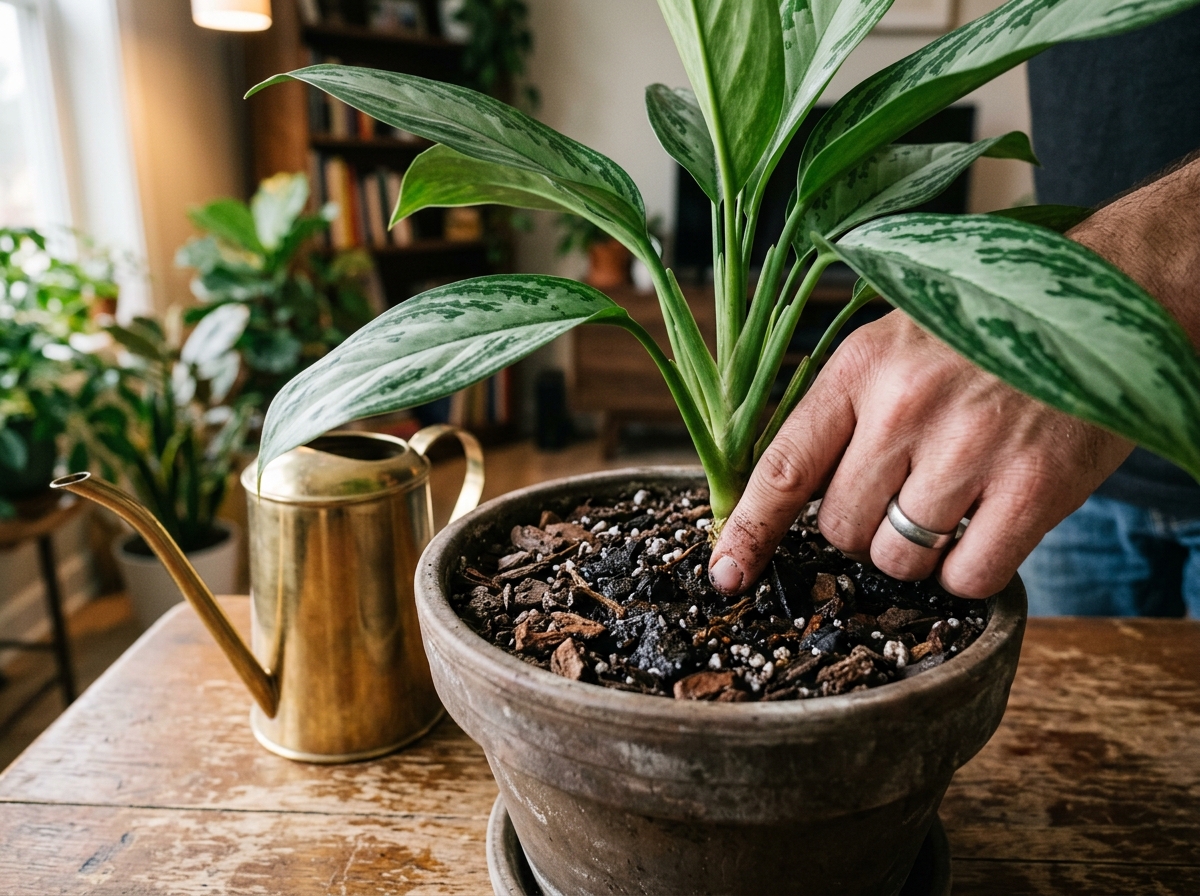
Allow the top one to two inches of potting mix to dry completely before irrigating. Test substrate moisture by inserting an unvarnished wooden dowel or digital moisture sensor into the center of the root ball; if the dowel emerges clean and dry from the upper zone while the lower root core feels slightly cool and damp, irrigation is warranted. Apply lukewarm, room-temperature water evenly across the entire surface until ten to twenty percent of the liquid drains freely from bottom drainage holes. This thorough flushing rehydrates all root zones, dissolves stagnant fertilizer salts, and pulls fresh oxygen into the substrate pores as water drains away. Always empty drainage saucers after twenty minutes to prevent bottom saturation. If you notice lower leaves losing turgor or developing chlorosis, refer to our diagnostic protocol on Why Are My Plant Leaves Turning Yellow: 7 Proven Fixes.
For growers looking to hydrate dense, multi-cane root balls evenly without disturbing delicate surface roots, exploring our guide on bottom watering indoor plants provides a gentle, root-friendly method for saturating container substrates uniformly from below.
3. Substrate Engineering, Aeration Porosity, and Mineral Salt Sensitivity
Standard bagged potting soil composed mostly of fine milled peat moss compacts rapidly after multiple irrigations, collapsing vital pore networks into an impermeable block. High-performing substrate for areca palm houseplants requires intentional engineering that delivers thirty percent air-filled porosity while preserving adequate water retention.
Dennis recommends formulating an open, fast-draining sandy loam blend: combine forty percent quality potting soil or coco coir, thirty percent coarse horticultural sand or fine pumice, twenty percent coarse horticultural perlite or small pine bark nuggets, and ten percent nutrient-rich worm castings. The horticultural sand and perlite provide non-collapsing structural macropores that resist compaction and allow gravitational water to drain immediately. Simultaneously, the coco coir and worm castings offer high cation exchange capacity (CEC), electrically holding onto essential positively charged nutrient ions—such as potassium (K+), calcium (Ca2+), and magnesium (Mg2+)—until fine root hairs absorb them. Explore substrate optimization in our detailed guide on creating a balanced houseplant soil mix.
Equally critical is water chemistry. Areca palm houseplants are uniquely sensitive to municipal tap water containing fluoride, chlorine, chloramines, and high dissolved mineral salts. Fluoride does not evaporate from standing water; when absorbed by roots, it translocates to the furthest leaflet margins, where water evaporates, leaving toxic fluoride concentrations that kill leaf tissue and cause permanent brown necrotic tips with yellow halos. Always irrigate areca palms using rainwater, distilled water, or reverse-osmosis filtered water to preserve pristine leaflet tips.
4. Ambient Temperature and Vapor Pressure Deficit (VPD)
Most tropical palms operate at optimal enzymatic efficiency within a temperature range of 65°F to 80°F (18°C to 27°C). Sustained exposure to temperatures below 50°F (10°C) causes cellular cytoplasmic chilling injury, inhibits enzyme function, and triggers sudden foliage collapse. Avoid placing containers near drafty exterior doorways, unsealed single-pane windows, or air conditioning vents.
Equally critical is vapor pressure deficit (VPD)—the difference between the moisture pressure inside the leaf and the moisture pressure of the surrounding room air. In winter, heated living spaces often experience relative humidity dropping below thirty percent. High VPD accelerates transpiration beyond what roots can resupply, causing delicate leaflet margins to curl, brown, and turn crispy. Operating an ultrasonic cool-mist humidifier to maintain relative humidity between 55% and 65% stabilizes VPD, keeping foliar cell walls supple, improving stomatal conductance, and minimizing leaf tip burn.
5. Measured Fertilization, Mobile Nutrient Reserves, and Pruning Hygiene
Because potted houseplants live in closed systems, soluble mineral ions are gradually depleted through root absorption and leaching. Supplying supplementary plant food during active spring and summer growth sustains vigorous vegetative flushes. However, concentrated synthetic salts can easily scorch delicate root hairs. Dennis advises using a specialized palm fertilizer with an N-P-K ratio such as 8-2-12 or 12-4-12 containing magnesium and micronutrients, diluted to one-half of the manufacturer’s recommended strength, applied monthly from April through August.
Always apply liquid fertilizer to pre-dampened potting soil, never to bone-dry substrate, to avoid osmotic shock. Completely halt all fertilizer applications from October through early March. In addition, respect the palm’s mobile nutrient reserves: never prune fronds that are merely yellow or pale green. As fronds age, the palm naturally translocates mobile potassium from older lower fronds into the central growing spear. Pruning a yellow frond prematurely deprives the palm of essential potassium, forcing it to sacrifice the next tier of green fronds. Only prune fronds that have turned 100% brown and brittle, cutting flush with the cane using shears sterilized with 70% isopropyl alcohol.
Culture and Environmental Management Matrix
To assist indoor growers in fine-tuning environmental parameters for areca palm houseplants, Dennis Hansen has compiled this structured cultural reference matrix outlining target benchmarks and practical interventions:
| Care Parameter | Optimal Target Range | Dennis’s Essential Grower Guidance |
|---|---|---|
| Light Intensity | Bright, filtered indirect daylight (300–600 Foot-Candles) | Avoid harsh midday summer glare; rotate container 90 degrees bi-weekly to preserve upright, symmetrical canes. |
| Irrigation Rhythm | Top 1–2 inches dry before soaking; drench thoroughly | Always discard standing runoff from drainage saucers after 20 minutes to prevent bottom waterlogging and root hypoxia. |
| Substrate Mix | Fast-draining sandy loam palm blend (pH 6.0–6.5) | Incorporate 30% coarse horticultural sand and 20% perlite to ensure rapid gravitational drainage and root oxygenation. |
| Temperature Window | 65°F to 80°F (18°C to 27°C) | Protect containers from cold winter window drafts and forced-air heating registers below 50°F. |
| Relative Humidity | 55% to 65% Ambient Humidity | Operating an ultrasonic cool-mist humidifier prevents crispy leaflet tips and discourages spider mite outbreaks. |
| Nutrient Delivery | Specialized palm fertilizer (8-2-12 N-P-K) at 1/2 strength | Feed monthly during active spring/summer growth; suspend all fertilizer during autumn and dark winter months. |
Dennis’s Advanced Diagnostic Troubleshooting: 7 Critical Solutions
When environmental conditions diverge from biological needs, areca palm houseplants display distinct physiological warning signs. Use this systematic diagnostic protocol covering seven common indoor challenges to restore your palms to prime health:
1. Brown, Crispy Leaflet Tips Across the Canopy
What the symptom looks like: The tips of individual leaflets turn dry, brown, and brittle, often separated from healthy green tissue by a thin yellow chlorotic band, while the rest of the frond remains green.
Possible cause: Fluoride and mineral salt toxicity from municipal tap water, chronically low ambient humidity (below 40%), or allowing the root ball to dry down to bone-dry dust.
How to identify the cause: Check your water source and room humidity. If you use city tap water and room humidity registers under 40%, fluoride accumulation and dry air are the dual culprits. Fluoride burn typically features a sharp yellow border separating the brown tip from green tissue.
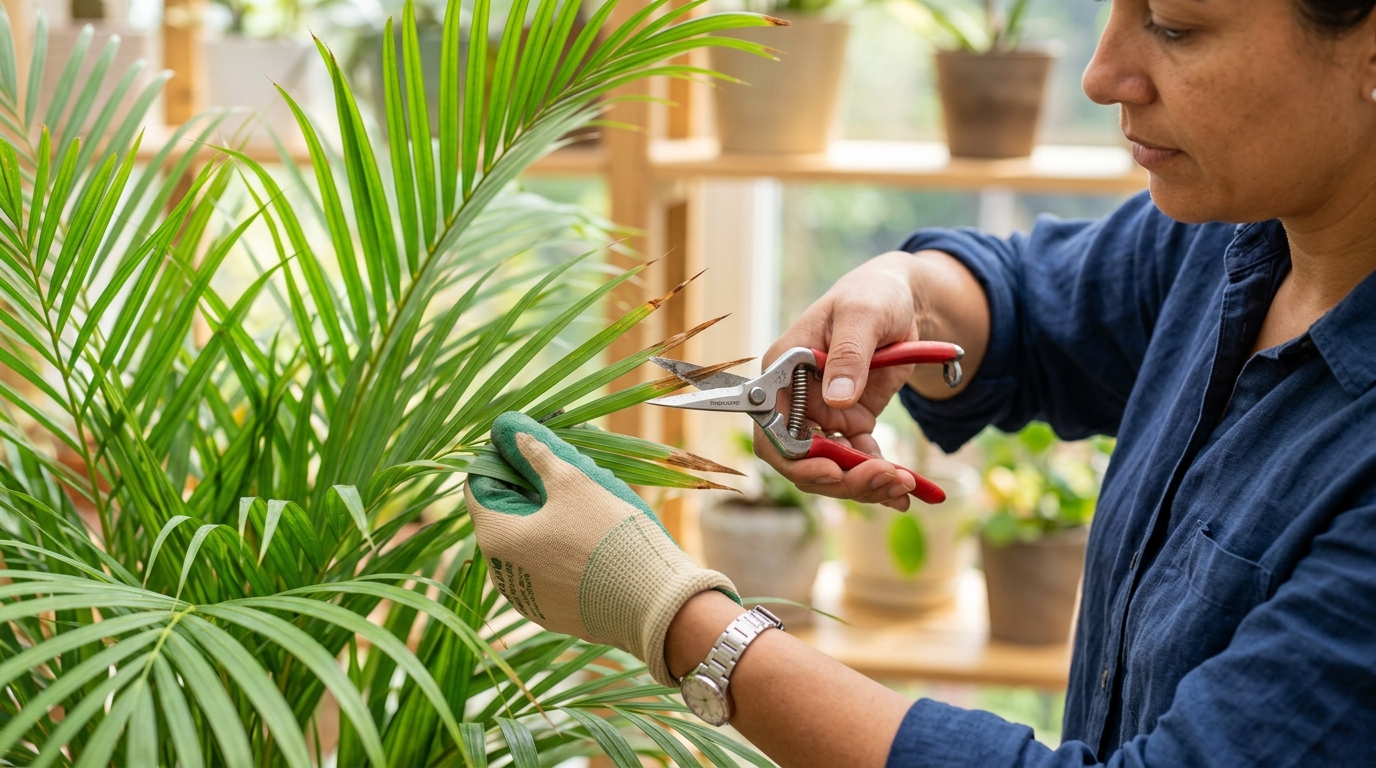
What to do: Trim the brown tips using sharp, sterilized floral shears. Always leave a tiny 1-millimeter margin of brown tissue intact; cutting directly into green living tissue opens a fresh cellular wound that triggers immediate browning further down the leaflet. Switch immediately to rainwater, distilled water, or reverse-osmosis filtered water. Elevate room humidity to 55% to 65% using an ultrasonic cool-mist humidifier.
How to prevent the problem: Never use fluoridated municipal tap water or water softened with sodium salts. Maintain indoor humidity consistently above 50% year-round.
2. Widespread Yellowing Fronds & Natural Speckled Canes
What the symptom looks like: Older lower fronds turn pale chartreuse, then bright golden yellow, while the lower canes display irregular brown, black, or reddish speckles near the soil line.
Possible cause: Overwatering suffocating the lower root zone, natural baseline senescence, or acute potassium and magnesium deficiency in depleted potting mix.
How to identify the cause: First, examine the dark spots on the canes: small brown or black speckles on areca canes are completely natural botanical markings, not a fungal disease. If yellowing fronds feel limp and the soil remains cold, heavy, and wet several inches down, overwatering is the primary problem. For complete symptom diagnostic workflows, review our guide on Why Are My Plant Leaves Turning Yellow: 7 Proven Fixes.
What to do: If overwatered, hold off on watering and allow the top two to three inches of potting mix to dry out completely. Loosen the topsoil with a wooden chopstick to introduce oxygen. If the soil is well-draining and properly managed, apply a dedicated palm fertilizer containing chelated magnesium and potassium to correct nutritional chlorosis.
How to prevent the problem: Confirm root-zone dry-back before watering, and feed with balanced palm fertilizers containing essential micronutrients during spring and summer.
3. Drooping, Limp Canes & Collapsed Fronds
What the symptom looks like: Canes lose their upright structural rigidity and splay outward; feathery fronds droop limp and listless over the rim of the container.
Possible cause: Severe root-zone drought (underwatering) OR advanced root rot (overwatering) that has destroyed the root system’s ability to pull water upward.
How to identify the cause: Lift or tilt the container. If the pot feels weightless and the potting mix has pulled away from the inner container walls, the palm is severely dehydrated. If the container feels heavy and waterlogged, roots have drowned and rotted away.
What to do: If the palm is dehydrated, place the container in a basin of lukewarm water and bottom-soak for 30 minutes until the root ball is thoroughly rehydrated. If the soil is waterlogged, unpot the palm, gently wash away old soil, cut away all rotted roots, and repot into fresh, sandy palm mix.
How to prevent the problem: Maintain consistent moisture in the lower root ball without allowing standing water to pool in the drainage saucer.
4. Anaerobic Root Rot Breakdown (Phytophthora & Fusarium)
What the symptom looks like: Fronds turn a dull, grayish-brown color across multiple canes, the base of the stems feels soft and mushy near the soil, and the container gives off a sour, swampy odor.
Possible cause: Anaerobic water mold infection resulting from compacted, dense potting soil, blocked drainage holes, and chronic overwatering.
How to identify the cause: Inspect the root ball. Healthy areca palm roots are firm, flexible, and light orange-tan or pale cream. Rotted roots appear dark brown or black, feel slimy, and slide apart between your fingers like wet thread.
What to do: Gently rinse all old soggy potting mix from the root system under running lukewarm water. Prune away every trace of soft, dark, rotted roots using shears sterilized in 70% rubbing alcohol. Soak the remaining healthy root system in a diluted solution of one part 3% hydrogen peroxide to four parts water for 10 minutes to eradicate fungal spores. Repot into a clean, unglazed terracotta container using a fresh, sterile mix high in coarse horticultural sand and perlite. Position the palm in gentle, bright indirect light and keep the substrate barely damp until new spear fronds emerge.
How to prevent the problem: Always use containers with open drainage holes, formulate fast-draining sandy loam potting mix, and discard drainage saucer runoff after 20 minutes.
5. Common Pests: Spider Mites & Scale Insects
What the symptom looks like: Fine, silky webbing drapes between leaflets accompanied by dusty yellow stippling across the fronds (spider mites), or small, waxy, oval brown bumps adhere tightly to the canes and frond stems (scale).
Possible cause: Dry indoor winter heating providing ideal breeding conditions for spider mites, or scale insects introduced from newly purchased nursery plants.
How to identify the cause: Inspect the undersides of leaflets with a 10x jeweler’s loupe. Spider mites appear as tiny moving red, yellow, or two-spotted specks; scale insects appear as immobile, waxy bumps that produce sticky sap (honeydew).
What to do: Take the palm to the bathroom shower and wash the fronds thoroughly with lukewarm water to physically dislodge pests. Coat all frond surfaces and canes with insecticidal soap or diluted cold-pressed neem oil mixed with warm water and a drop of mild Castile soap. Repeat applications every five to seven days for three weeks. For stubborn scale on thick canes, apply systemic insecticide granules to the soil surface.
How to prevent the problem: Maintain indoor relative humidity above 55% (spider mites thrive in dry, dusty air) and rinse the foliage under a lukewarm shower every two months.
6. Fungal Leaf Spot (Helminthosporium & Cercospora)
What the symptom looks like: Small, circular reddish-brown, tan, or black spots surrounded by bright yellow halos appear scattered across individual leaflets.
Possible cause: Fungal spore germination encouraged by overhead water misting, water splashing onto foliage, and stagnant room air.
How to identify the cause: Examine the spots under bright light. If the spots feature a distinct circular yellow halo and are clustered on foliage that was frequently sprayed with a hand mister, fungal leaf spot is present.
What to do: Prune away heavily infected fronds with sterilized bypass shears. Stop all foliage misting immediately. Increase room air movement using a small oscillating fan, and treat the remaining fronds with an organic copper-based fungicide spray.
How to prevent the problem: Keep foliage dry by applying water directly to the potting mix rather than the fronds, and provide gentle, continuous room air circulation. Research published by the University of Hawaii Extension on Palm Diseases emphasizes that eliminating standing water droplets on palm leaves is the most effective cultural barrier against fungal pathogen penetration.
7. Bleached, Pale Fronds from Sudden Sunburn
What the symptom looks like: Upper fronds lose their deep emerald-green hue, turning bleached white, parchment-like, or translucent yellow-tan within 24 to 48 hours.
Possible cause: Sudden exposure to intense, unbuffered direct sunlight through south- or west-facing window glass.
How to identify the cause: Check the sunlight exposure pattern. If bleached foliage is restricted entirely to the side of the palm facing the window, sunburn is the definitive cause.
What to do: Move the palm three to five feet back from the glass or install sheer linen curtains to filter the midday rays. Scorched leaflets will not regain their green color, but they should be left in place until new fronds emerge to shade the lower canopy.
How to prevent the problem: Acclimate indoor palms gradually to brighter light conditions over two weeks, allowing leaf cells to build photoprotective pigments.
Seasonal Adjustments: Spring Through Winter Cycles
Indoor plants adapt their internal biology according to outdoor celestial rhythms. Aligning your cultural routines with the changing seasons ensures year-round health for areca palm houseplants:
Spring (March Through May): Awakening and Spear Emergence
As day lengths extend and outdoor temperatures warm, areca palms exit winter rest and initiate active vegetative flushes. Fresh, tightly furled spear fronds emerge from the center of mature canes, and root tips expand rapidly through the substrate. During spring, increase watering frequency as cellular transpiration rates rise. This is the optimal window for repotting root-bound specimens into containers two inches larger, gently loosening the outer root perimeter while preserving the central root ball intact. Resume balanced liquid palm fertilization at one-half strength every four weeks.
Summer (June Through August): Peak Metabolic Photosynthesis
Summer brings maximum natural day length and solar intensity. Indoor temperatures often rise, driving rapid soil moisture evaporation. Check containers every four to five days using a wooden moisture probe. Move plants slightly further back from intense south- or west-facing windows to avoid solar heat scorch. Maintain continuous ventilation and air movement to prevent fungal spores from establishing on foliage during humid summer spells, and sustain regular monthly feeding. Rinse fronds in the shower every six weeks to clear dust.
Autumn (September Through November): Hardening and Pre-Winter Preparation
With photoperiods contracting and ambient solar angles lowering, indoor plant metabolism gradually slows. Frond expansion slows down, and water uptake diminishes. Begin spacing out watering intervals, allowing the upper half of the potting soil to dry before irrigating. Taper off and completely halt liquid fertilizer applications by late October to prevent tender unhardened foliage flushes that become vulnerable to indoor pests and dry air.
Winter (December Through February): Conserving Energy and Humidity Defense
Winter presents the most challenging indoor environment, characterized by low light levels, short photoperiods, and dry indoor heating. Water consumption drops to a fraction of summer rates; irrigate conservatively every seven to ten days only after deep soil testing. Move containers closer to unobstructed window glass to capture scarce winter photons, while ensuring foliage does not touch cold windowpanes. Never apply fertilizer to dormant winter roots, and run an evaporative room humidifier to counteract drying furnace air, maintaining ambient humidity above 55%.
Master FAQ: In-Depth Expert Answers on areca palm houseplants
How often should areca palm houseplants be watered indoors?
During active spring and summer growth, areca palm houseplants generally require thorough watering every five to seven days, but growers should never irrigate according to a rigid calendar schedule. Real-world moisture depletion rates vary significantly based on ambient indoor temperatures, relative humidity levels, sunlight intensity, pot diameter, and container material (such as porous unglazed terracotta versus non-porous glazed ceramic). Always evaluate the potting substrate directly by inserting an unvarnished wooden dowel or digital moisture meter two inches into the root ball. Water only when this upper zone feels dry and crumbly while the lower core remains damp. When irrigating, apply lukewarm water evenly across the entire surface until ten to twenty percent drains freely through bottom drainage holes, ensuring full hydration of the lower root mass. Always discard standing runoff from drainage saucers after twenty minutes to prevent root-zone hypoxia. During winter rest, extend irrigation intervals to every seven to ten days.
Why are the tips of my areca palm fronds turning brown and crispy?
Brown, crispy tips on areca palm fronds are most commonly caused by fluoride and mineral salt toxicity from municipal tap water, low ambient indoor humidity (under 40%), or letting the root ball dry out completely. Areca palms are exceptionally sensitive to fluoride and chlorine, which accumulate at the tips of leaflets over time, killing tissue and causing brown tips with yellow halos. To resolve this issue, switch to watering with rainwater, distilled water, or reverse-osmosis filtered water, maintain indoor relative humidity above 55% using an ultrasonic cool-mist humidifier, and keep the lower root ball consistently slightly moist. When trimming brown tips, always leave a 1mm margin of dry brown tissue intact to avoid cutting into living green cells, which prompts fresh necrosis.
Can I separate or divide the canes on an areca palm houseplant?
No, you should avoid separating or dividing the individual canes of an areca palm houseplant. The areca palms sold in garden centers are clusters of individual seedlings grown closely together to create a full, bushy appearance. Their fibrous root systems weave into a dense, delicate mat that cannot be separated without ripping and destroying fine feeder root hairs. Attempting to untangle or slice the canes apart causes severe transplant shock that typically kills a large percentage of the stems. If your palm outgrows its container, repot the entire root ball intact into a slightly larger pot, stepping up by no more than two inches in diameter and backfilling with fresh sandy loam potting mix.
What is the best potting soil mix for areca palm houseplants?
The best potting soil for areca palm houseplants is a loose, slightly acidic, and fast-draining sandy loam mix with a pH between 6.0 and 6.5 that retains gentle moisture without waterlogging. Never use standard bagged potting soil alone, which compacts and suffocates root hairs. A reliable DIY formulation consists of 40% quality potting soil or peat moss for moisture retention, 30% coarse horticultural sand or fine pumice to create open drainage channels that mimic native riverbank soils, 20% coarse perlite or small pine bark for aeration, and 10% worm castings for gentle nutrition. This structure drains excess gravitational water freely within seconds while maintaining aerated pockets where root systems can thrive.
Why does my areca palm have brown or black speckles on its canes?
Small brown, black, or reddish speckles on the lower canes of an areca palm are completely normal botanical characteristics and are not a sign of fungal disease or pest infestation. Botanically named Dypsis lutescens (with lutescens meaning yellowish), areca palms naturally feature fine dark speckles and golden-yellow coloration along their mature stems. However, if the spots are raised, waxy, and can be scraped off with a fingernail, they may be scale insects. If the spots are smooth, flush with the cane bark, and accompanied by healthy fronds, they are natural markings that develop as canes mature.
How much sunlight do areca palm houseplants need indoors?
An areca palm houseplant thrives best in bright, indirect sunlight, ideally receiving between 300 and 600 foot-candles (3,000 to 6,000 lux) for six to eight hours each day. Gentle morning sun from an east-facing window is exceptional, while intense afternoon rays from unshaded south- or west-facing windows should be softened with sheer curtains to prevent leaf scorch and bleached foliage. While areca palms can tolerate moderate light, placing them in dim corners causes weak, stretching canes, pale foliage, and rapid lower frond loss as the plant sheds vegetative mass it cannot support. Rotate the pot 90 degrees every two weeks to encourage straight, symmetrical cane growth.
Authoritative Horticultural References
For verified botanical taxonomy, palm environmental physiology, and university extension research on Dypsis lutescens, consult these authoritative academic resources:
- University of Florida IFAS Extension: Areca Palm (Dypsis lutescens) Landscape and Interior Care — Research bulletin on palm nutrition, micronutrient balancing, and light requirements.
- Clemson University Cooperative Extension: Indoor Palms Care and Troubleshooting — Comprehensive guide covering soil drainage, water fluoride sensitivity, and indoor humidity protocols.
- University of Hawaii Extension: Diseases of Palms — Clinical plant pathology research on fungal leaf spot, root rot prevention, and physiological disorders in palms.
Dennis P. Hansen
Dennis P. Hansen is a home gardener with a genuine passion for plants and the simple pleasure of growing them. He enjoys caring for houseplants, succulents, and other plants at home while continually learning from everyday gardening experiences. Dennis likes to share practical plant care tips, useful observations, and simple solutions that can help others grow healthier plants. He believes that caring for plants is a rewarding journey and that there is always something new to learn along the way.