
Monstera Deliciosa Care: 7 Secrets for Huge Leaf Splits

Mastering monstera deliciosa care is the crowning achievement of the modern indoor plant enthusiast, creating breathtaking architectural statements of massive, deep-emerald leaves punctured by magnificent natural splits and secondary pinhole fenestrations. Native to the dense tropical rainforests of southern Mexico and Central America, Monstera deliciosa is a vigorous hemiepiphyte that scrambles up jungle tree trunks toward the sunlit canopy. When provided vertical support and ample illumination indoors, juvenile heart-shaped leaves rapidly transform into giant fenestrated masterpieces. In our greenhouse trials, combining moist sphagnum moss poles with chunky aroid substrates unlocks maximum leaf morphogenesis.
| Diagnostic Parameter | Dennis’s Observation | Corrective Action |
|---|---|---|
| Solid Leaves Without Splits (No Fenestrations) | Sub-optimal light levels (<150 foot-candles) or absence of vertical climbing support. | Stake to a moist sphagnum moss pole; increase light to 300+ foot-candles. |
| Yellowing Foliar Margins with Brown Centers | Root hypoxia and rot caused by dense, waterlogged peat soil. | Repot into chunky 50% pine bark aroid mix; allow top half to dry between waterings. |
| Long, Wandering Brown Aerial Roots | Natural foraging roots seeking structural anchors and secondary moisture. | Direct aerial roots down into the soil substrate or tuck into a damp moss pole. |
| Sweating / Droplets on Leaf Tips (Guttation) | Excessive soil moisture expelled through hydathodes under high root pressure. | Normal physiological process; reduce watering frequency slightly. |
Table of Contents: Jump to a Section
- Central American Rainforest Ecology: The Hemiepiphytic Climber
- 7 Secrets: Monstera Deliciosa Care for Huge Splits
- Leaf Morphogenesis & The Evolutionary Biology of Fenestrations
- Vertical Moss Pole Staking & Aerial Root Dynamics
- Chunky Aroid Substrates & Oxygen Diffusion
- Frequently Asked Questions (FAQ)
Central American Rainforest Ecology: The Hemiepiphytic Climber
In its native Neotropical habitats, Monstera deliciosa uses negative phototropism (growing toward darkness) as a seedling to find the nearest tree trunk. Once attached via adventitious aerial roots, it climbs upward into the light canopy, producing leaves that can exceed 3 feet across.
Taxonomic and ecological studies from the Missouri Botanical Garden demonstrate that Monstera deliciosa develops progressive leaf fenestrations primarily in response to vertical climbing support and increased luminous flux.
7 Secrets: Monstera Deliciosa Care for Huge Splits
Secret 1: Stake Securely to a Moist Sphagnum Moss Pole
Without physical climbing support, Monstera stems sprawl horizontally and leaves stay small and un-fenestrated. Anchor the central stem to a sturdy moss pole using plant velcro, misting the pole weekly so aerial roots penetrate.
Secret 2: Provide 250 to 450 Foot-Candles of Indirect Sun
Monsteras require generous light to generate secondary pinhole fenestrations. Position your specimen 3 to 5 feet from an unobstructed south- or east-facing window.

Secret 3: Plant in a High-Porosity Chunky Aroid Mix
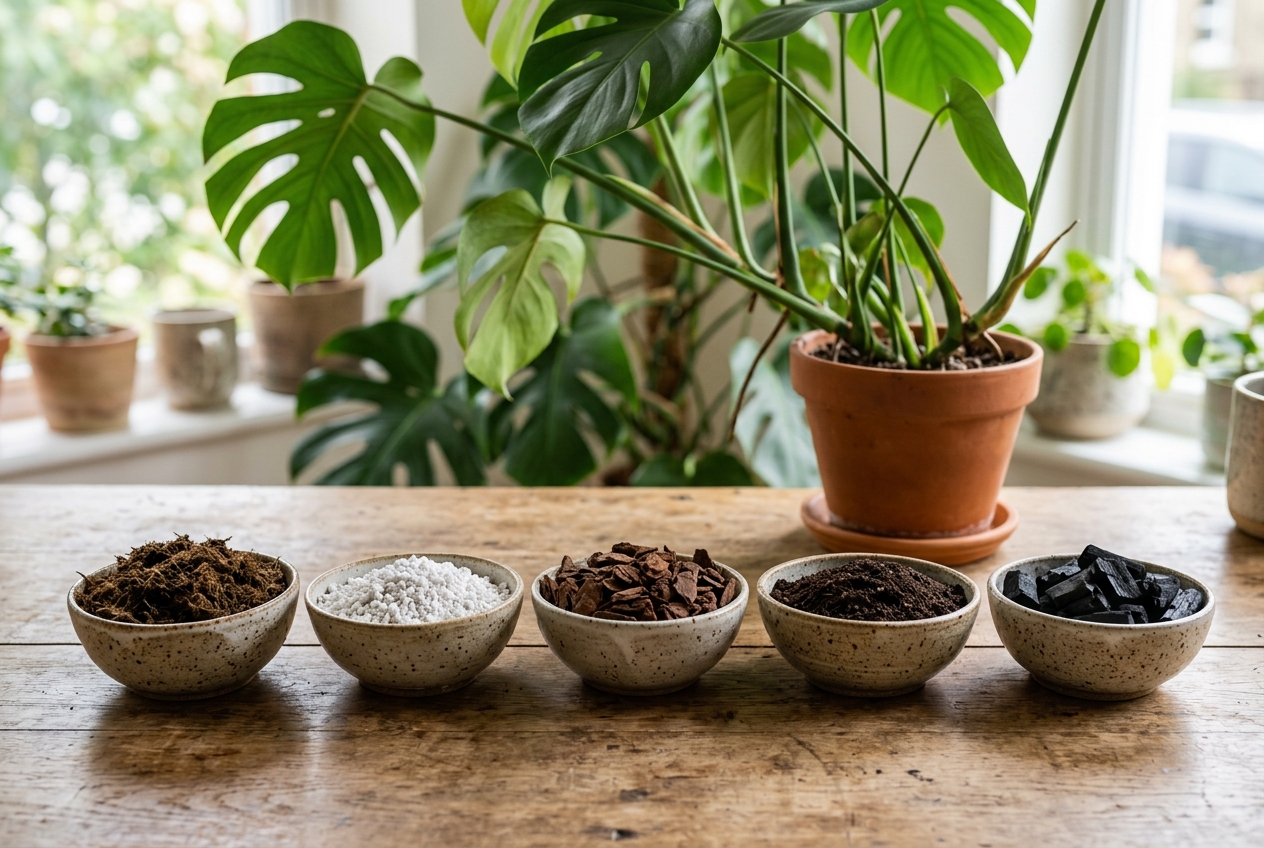
Combine 40% coarse pine bark, 25% perlite, 20% coco coir, 10% worm castings, and 5% horticultural charcoal. This recipe ensures continuous oxygen diffusion around root hairs.
Secret 4: Guide Wandering Aerial Roots Down into Soil
As brown aerial roots emerge from stem nodes, direct them downward into the container soil. Once anchored, they develop functional subterranean feeder root networks that supercharge foliar growth.
Secret 5: Water Deeply When Top 50% Dries Out
Soak the entire root ball thoroughly until water pours from container drainage holes. Never let the pot sit in standing drainage water for longer than 20 minutes.

Secret 6: Apply Balanced 3-1-2 Nitrogen Nutrients Monthly
Feed every 4 weeks during spring and summer with a balanced liquid fertilizer (such as 9-3-6 NPK) diluted to half strength. Nitrogen fuels cellular expansion in expanding leaf blades.
Secret 7: Dust and Sponge Leaves with Soft Water Monthly
Dust buildup blocks stomatal respiration and cuts light absorption by up to 25%. Wipe leaves with a damp microfiber cloth moistened with clean lukewarm water.
Leaf Morphogenesis & The Evolutionary Biology of Fenestrations
Plant researchers and home gardeners hypothesize that leaf fenestrations (splits and holes) allow high-altitude canopy winds to pass through without tearing the leaf blade, while permitting dappled sunlight to reach lower foliage.
To formulate the ideal potting mix for your vine, read our tested recipe in Best Soil Mix for Monstera. If you are debating between organic bark and mineral mediums, compare substrates in Lechuza Pon vs Aroid Soil.
Frequently Asked Questions (FAQ)
Why does my Monstera leaf have no splits?
Lack of fenestrations is caused by two factors: low light and young plant age. Move the plant closer to indirect sunlight and provide a vertical moss pole to trigger split formation.
Can I cut off Monstera aerial roots?
Yes, trimming aerial roots does not harm the plant. However, tucking them into the soil provides extra water and nutrient uptake that dramatically accelerates growth.
Is Monstera deliciosa toxic to cats and dogs?
Yes. Monstera deliciosa contains insoluble calcium oxalate crystals that cause mouth irritation, swelling, and drooling if chewed by pets. Keep plants out of pet reach.
How often should I repot my Monstera?
Young Monsteras need repotting every 12 to 18 months into a pot 2 to 3 inches larger. Mature specimens can remain in the same container for 2 to 3 years with annual soil top-dressing.
Dennis P. Hansen
Dennis P. Hansen is a home gardener with a genuine passion for plants and the simple pleasure of growing them. He enjoys caring for houseplants, succulents, and other plants at home while continually learning from everyday gardening experiences. Dennis likes to share practical plant care tips, useful observations, and simple solutions that can help others grow healthier plants. He believes that caring for plants is a rewarding journey and that there is always something new to learn along the way.