
How to Get Rid of Gnats in Houseplants: 7 Best Relief Steps


Few indoor gardening frustrations compare to watching clouds of tiny black flies scatter into the air every time you bump a flowerpot or take a sip of water. I am Dennis P. Hansen, and in my years of cultivating diverse foliage collections, I have battled fungus gnat infestations and tested every biological and cultural remedy available. In this comprehensive guide, you will learn how to get rid of gnats in houseplants, understand the four stages of the sciarid fly life cycle, and implement proven biological controls that eliminate both larvae and adults permanently.
Table of Contents
- The Biology and Life Cycle of Fungus Gnats
- How Gnat Larvae Damage Root Systems
- The 7-Step Gnat Eradication Protocol
- Gnat Control Methods Comparison Matrix
- Biological Warfare: BTI and Beneficial Nematodes
- Soil Pasteurization and Sterile Substrate Preparation
- Dennis’s Advanced Troubleshooting for Persistent Infestations
- Long-Term Prevention and Soil Management
- Master FAQ: Fungus Gnats in Houseplants
The Biology and Life Cycle of Fungus Gnats
To successfully eradicate gnats from your living space, you must first understand the biological adversary you are confronting. The insects commonly known as fungus gnats belong primarily to the dipteran families Sciaridae and Mycetophilidae (most frequently Bradysia species). These delicate, dark-bodied insects measure between one-eighth and one-sixteenth of an inch in length and are often mistaken for common fruit flies (Drosophila melanogaster). While fruit flies are attracted to fermenting fruit and sweet beverages, fungus gnats are strictly soil-borne organisms drawn to damp, decomposing organic matter and subterranean fungal spores.
The fungus gnat life cycle progresses through four distinct stages: egg, larva, pupa, and adult. Under typical residential indoor temperatures (68°F to 75°F), this entire cycle completes in approximately 17 to 24 days. A single mated female adult can deposit up to 200 microscopic eggs directly into the top two inches of damp potting substrate. Within four days, these eggs hatch into translucent, legless larvae with distinctive shiny black head capsules.
The larval stage represents the primary destructive phase, lasting 10 to 14 days. During this period, hundreds of subterranean larvae feed voraciously on decaying organic components, soil fungi, and tender root hairs. After completing their larval development, they spin subtle silk cocoons in the upper soil to pupate, emerging three to four days later as winged adults ready to mate and repeat the reproductive cycle. According to entomological bulletins from Colorado State University Extension on fungus gnats as indoor pests, disrupting this life cycle requires a multi-pronged attack that targets both adult flies above ground and developing larvae beneath the surface.
How Gnat Larvae Damage Root Systems
While adult fungus gnats are harmless to plant tissue and do not bite humans, their presence inside a home is an irritating nuisance. The true botanical threat lies concealed beneath the potting soil. In modest numbers, gnat larvae feed primarily on saprophytic fungi and rotting bark fines. However, as larval populations multiply inside confined containers, their food resources deplete.
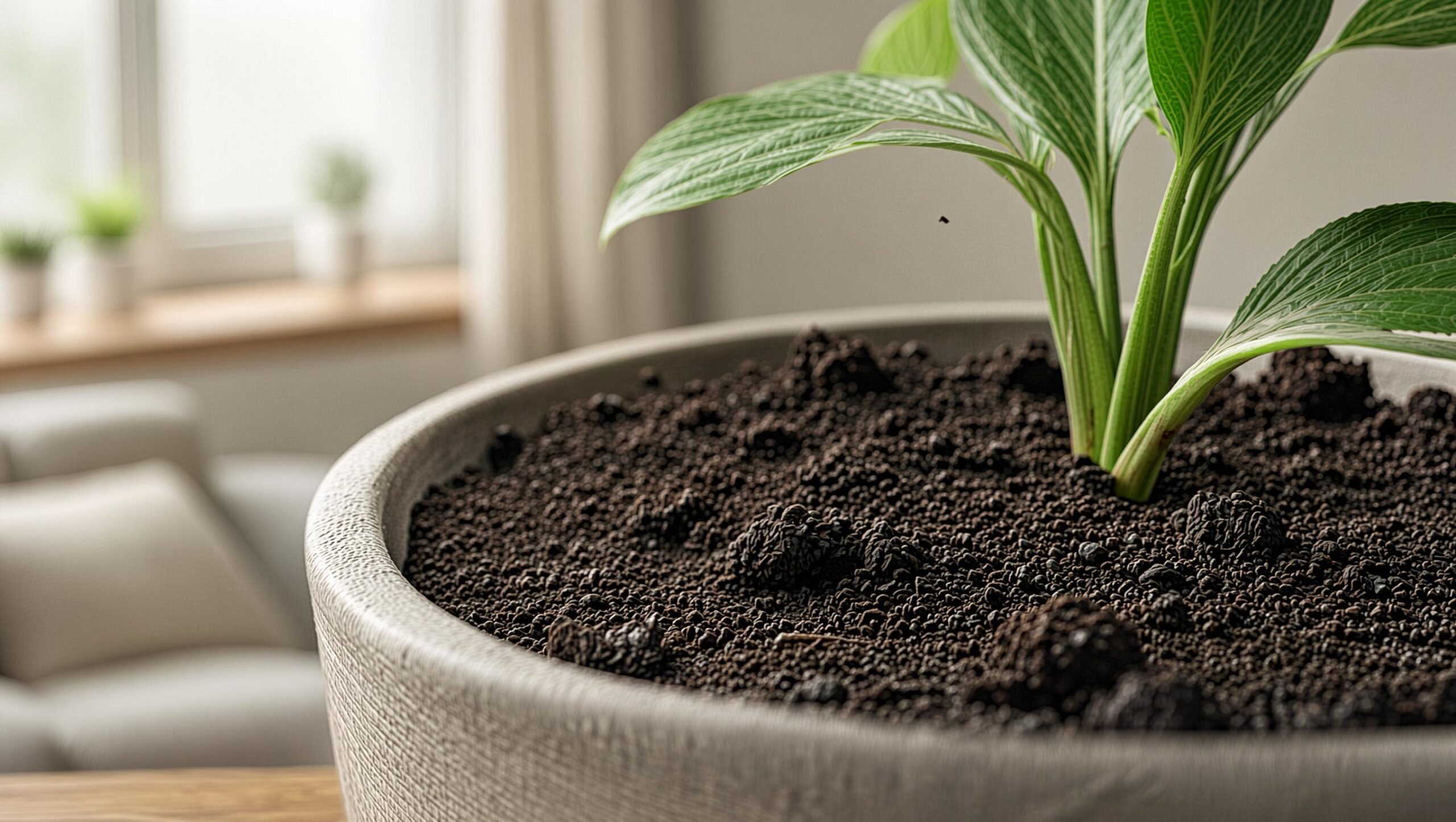
When hungry larvae exhaust surface fungi, they turn to living root structures. They chew through fine epidermal root hairs, taproots, and underground rhizomes. This feeding damage strips the plant’s capacity to absorb water and dissolved minerals from applied houseplant fertilizer solutions. Even more critically, the microscopic feeding wounds created by gnats provide direct entry portals for lethal root rot pathogens, including Pythium, Fusarium, and Rhizoctonia. A plant with damaged roots exhibits mysterious yellowing leaves, stalled growth, and sudden wilting despite damp soil.
The 7-Step Gnat Eradication Protocol
Eliminating an established gnat infestation requires a disciplined, multi-step treatment regimen executed consistently for at least three consecutive weeks.
Step 1: Enforce Strict Soil Surface Desiccation
Fungus gnat eggs and young larvae have zero drought tolerance. If the top two to three inches of potting soil dries out completely, developing eggs desiccate and newly hatched larvae perish within 24 hours. Extend your watering intervals significantly, allowing drought-tolerant species like snake plants and ZZ plants to dry out completely. For sensitive tropicals, allow the top half of the container to become bone-dry before watering.
Step 2: Deploy Bright Yellow Sticky Traps
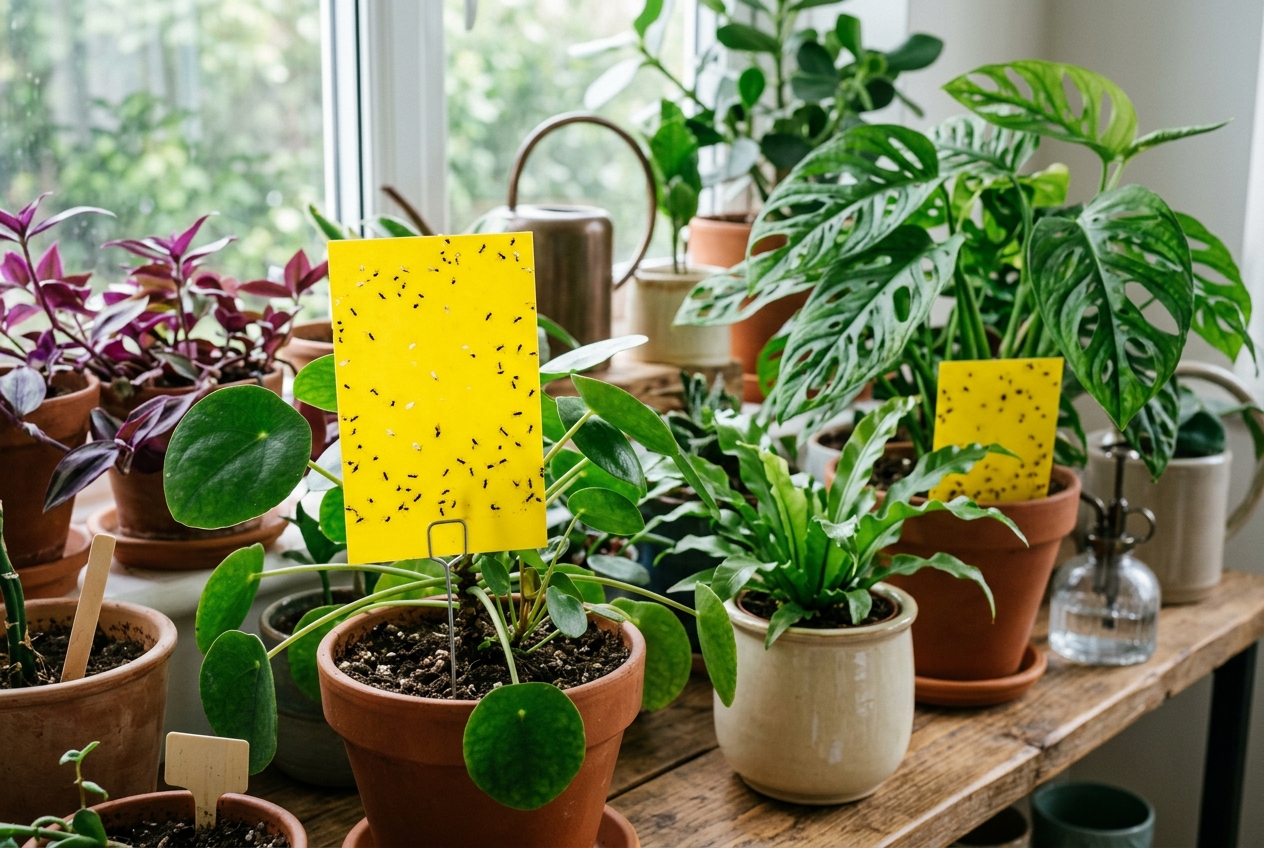
Adult gnats are strongly attracted to the visual wavelength of bright yellow. Cut rectangular yellow sticky cards into small squares or purchase decorative butterfly-shaped traps mounted on plastic stakes. Place one trap horizontally near the soil surface in every single potted plant across your home. Traps do not kill larvae, but they capture egg-laying adult females by the dozens, breaking the reproductive chain.
Step 3: Apply Bacillus thuringiensis israelensis (BTI)
BTI is a naturally occurring soil bacterium that produces delta-endotoxin proteins toxic exclusively to the digestive tracts of dipteran larvae (mosquitoes and fungus gnats). Soak commercial BTI granules (such as Mosquito Bits or Gnatrol) in warm irrigation water for thirty minutes, strain out the solids, and drench the potting soil thoroughly. When larvae consume the microscopic bacterial crystals, their gut membranes rupture, killing them within 24 to 48 hours while posing zero risk to plants, humans, or pets.
Step 4: Execute a 3% Hydrogen Peroxide Drench
If BTI is unavailable, standard household 3% hydrogen peroxide (Hâ‚‚Oâ‚‚) provides immediate chemical knockdown. Mix one part 3% hydrogen peroxide with four parts room-temperature water. Pour the effervescent mixture thoroughly through dry potting soil. Upon contact with organic matter, the peroxide fizzes, releasing reactive oxygen that destroys gnat larvae and eggs on contact before breaking down into harmless oxygen and pure water.
Step 5: Transition Exclusively to Bottom Watering
Because fungus gnats rarely burrow deeper than two inches below the surface, keeping the upper crust dry deprives them of breeding habitat. Submerge the lower third of pots in a basin of water for 30 minutes, allowing moisture to rise by capillary action into the lower root zone while leaving the top two inches completely dry. For a complete walkthrough of this technique, read our tutorial on how to bottom water plants correctly.
Step 6: Apply an Inert Physical Sand Barrier
Adult gnats cannot dig through coarse, abrasive minerals. Spread a uniform, half-inch layer of clean horticultural coarse sand or aquarium gravel across the entire soil surface of every pot. Adult gnats cannot penetrate the sharp sand layer to lay eggs, and newly emerging adults trapped below cannot crawl out, effectively sealing off the container.
Step 7: Inspect and Quarantine All New Additions
Most household infestations originate from a single newly purchased plant brought home from a commercial greenhouse. Never place a new plant directly beside established greenery. Enforce a strict two-week quarantine in a separate room, inspect the soil surface with a hand lens, and water with BTI before integrating the plant into your permanent display.
Gnat Control Methods Comparison Matrix
This comparative reference matrix summarizes the primary cultural, biological, and chemical treatments for eliminating fungus gnats in houseplants.
| Treatment Method | Target Life Stage | Application Cadence | Efficacy Speed | Safety Rating |
|---|---|---|---|---|
| Yellow Sticky Traps | Adult winged gnats | Continuous (replace when full) | Immediate mechanical capture | 100% Non-toxic & safe |
| BTI Drench (Mosquito Bits) | Subterranean larvae | Every watering for 3 weeks | 24–48 hours post-ingestion | Organic biological, pet-safe |
| 3% Hydrogen Peroxide (1:4) | Larvae and eggs on contact | Once every 7–10 days | Instant effervescent oxidation | Breaks down to water & oxygen |
| Beneficial Nematodes | Larvae in deep root zones | Single application (active soil) | 3–5 days active hunting | Live microscopic biologicals |
| Coarse Sand Barrier | Adult egg deposition | Permanent top-dress (0.5 inch) | Immediate physical exclusion | Mineral, completely safe |
| Complete Soil Dry-Out | Eggs and young larvae | Cultural watering discipline | 3–5 days desiccating crust | Natural cultural control |
Biological Warfare: BTI and Beneficial Nematodes
While chemical insecticides provide temporary knockdown, beneficial biological organisms deliver long-term suppression without introducing synthetic poisons into indoor living spaces. Two microscopic biological agents are particularly effective against fungus gnat larvae.

1. Bacillus thuringiensis israelensis (BTI)
BTI is widely regarded by professional greenhouse curators as the gold standard for gnat management. The bacterium produces specialized parasporal crystal proteins. When ingested by gnat larvae, the alkaline pH of the insect midgut activates the endotoxin, binding to cell membranes and creating pores that rapidly destroy the gut epithelium. Larvae cease feeding within hours and die within two days. Because human, feline, and canine digestive tracts are strongly acidic, BTI has zero impact on mammals.
2. Entomopathogenic Nematodes (Steinernema feltiae)
Beneficial nematodes are microscopic, unsegmented roundworms that naturally inhabit healthy outdoor soils. Steinernema feltiae is a cold-tolerant species that actively hunts fungus gnat larvae in moist substrate. Nematodes enter larvae through natural body openings and release symbiotic bacteria (Xenorhabdus spp.) that multiply and consume the host within 48 hours. Nematodes reproduce inside the deceased larva, producing thousands of new hunting progeny. As documented by the University of California IPM on fungus gnat management, beneficial nematodes provide self-sustaining biological protection throughout complex potting soils.
Soil Pasteurization and Sterile Substrate Preparation
A major recurring source of fungus gnat outbreaks is contaminated commercial potting mix. Manufacturers store vast pallets of bagged peat outdoors where wild gnats infiltrate the substrate through perforated ventilation holes. When you purchase a bag, it often contains hundreds of dormant microscopic eggs waiting for household warmth and watering to hatch.
To eliminate this threat before potting, practice thermal soil pasteurization. Spread commercial potting soil thinly across a metal baking pan, moisten it lightly, cover with aluminum foil, and bake in a conventional oven at 180°F (82°C) for 30 minutes. Use a meat thermometer to ensure the core temperature reaches at least 160°F, which reliably pasteurizes gnat eggs, larvae, weed seeds, and soil-borne fungal spores without releasing harmful phytotoxic chemical compounds. Allow the pasteurized soil to cool completely before using it for repotting.
Dennis’s Advanced Troubleshooting for Persistent Infestations
If you have implemented standard treatments but gnats persist, subtle cultural oversights are often keeping the colony alive. Here is how to diagnose and solve the five most common persistence dilemmas.
1. Gnats Persisting Despite Bone-Dry Surface Soil
What the symptom looks like: You have allowed the top two inches of soil to dry out completely, yet adult gnats continue emerging in large numbers every morning.
Possible cause: Bottom drainage breeding. Adult gnats are entering the container through drainage holes at the base and breeding in the damp soil residing at the bottom of the pot.
How to identify the cause: Lift the container and inspect the drainage saucer. If gnats crawl out from beneath the pot, the breeding zone is located in the drainage reservoir.
What to do: Empty all drainage saucers immediately after watering. Cover drainage holes from the outside with fine nylon mesh or pantyhose held in place with rubber bands, allowing water to drain while blocking insect entry.
How to prevent the problem: Never allow containers to sit in standing water trays.
2. Gnats Emerging from Household Sinks and Drains
What the symptom looks like: You observe small flies hovering around kitchen sink drains, bathroom utility sinks, or garbage disposals.
Possible cause: Confusion with drain flies (Psychodidae), or fungus gnats feeding on organic bio-sludge inside plumbing P-traps.
How to identify the cause: Cover the drain opening overnight with a piece of clear tape coated lightly with petroleum jelly; trapped fuzzy moth-like insects indicate drain flies rather than fungus gnats.
What to do: Pour a pot of boiling water down all household drains, followed by an enzymatic bio-drain cleaner to dissolve organic gelatinous sludge.
How to prevent the problem: Clean plumbing traps monthly with baking soda and vinegar.
3. White Larvae Visible in Saucer Runoff Water
What the symptom looks like: Tiny, translucent, thread-like worms with dark black head capsules wriggle actively in water pooled in the saucer tray.
Possible cause: Severe subterranean infestation where heavy irrigation dislodges mature larvae out of the drainage holes.
How to identify the cause: Larvae measure roughly one-quarter inch long and thrash with a rapid S-shaped motion in water.
What to do: Discard the runoff water immediately. Drench the soil with a double-strength BTI solution or 1:4 hydrogen peroxide dilution. Top-dress pots with coarse sand.
How to prevent the problem: Treat every plant in the room simultaneously; treating only one pot allows gnats to migrate.
4. Severe Leaf Yellowing Following Heavy Gnat Attack
What the symptom looks like: Foliage develops progressive chlorosis, wilting, and leaf drop even when soil moisture is appropriate. For additional foliar symptoms, review our diagnostic guide on why plant leaves turn yellow and how to fix them.
Possible cause: Extensive secondary root rot triggered by larval feeding wounds introducing soil-borne fungal pathogens.
How to identify the cause: Slide the root ball out; roots are brown, decayed, and smell marshy.
What to do: Wash away all old substrate. Trim off rotten roots with sterilized shears, dust the remaining healthy root ball with sulfur or cinnamon powder, and repot in fresh, sterile soil.
How to prevent the problem: Eliminate gnats immediately upon initial detection.
5. Commercial Potting Soil Bag Infested Before Opening
What the symptom looks like: You open a brand-new bag of commercial potting mix, and adult gnats fly out immediately.
Possible cause: Bags stored outdoors at garden centers absorbed rainwater through micro-perforations, allowing outdoor gnats to colonize the moist organic peat.
How to identify the cause: Condensation inside the unopened plastic bag and active flying insects upon unsealing.
What to do: Do not use the soil immediately. Spread the soil thinly on a baking sheet and bake at 180°F for 30 minutes to pasteurize, or pour boiling water through the soil in a bucket before use.
How to prevent the problem: Only purchase soil bags stored indoors under dry warehouse conditions.
Long-Term Prevention and Soil Management
Maintaining a gnat-free home requires establishing environmental conditions that deter reproductive colonization.
Modifying Potting Substrate Aeration
Fungus gnats require fine, decomposing organic particles (such as pulverized peat moss) to nourish fungal mycelium. Transition your indoor plants into aerated, chunky substrates formulated with 30% coarse perlite, 20% orchid bark fines, and 50% coco coir. Coarse bark and perlite dry out quickly at the surface, eliminating the stagnant moisture layer that gnats require to reproduce.
Airflow Management
Fungus gnats are exceptionally weak fliers. Positioning a small oscillating fan or ceiling fan on low speed near plant shelves generates gentle air movement that prevents adult gnats from landing on soil surfaces and depositing eggs. Gentle airflow also accelerates soil surface evaporation, naturally shortening the damp window.
Master FAQ: Fungus Gnats in Houseplants
Do fungus gnats bite humans or harm pets?
No, adult fungus gnats do not possess biting mouthparts and are biologically incapable of biting humans, dogs, or cats. They do not feed on blood, carry infectious human diseases, or reproduce on household furniture. However, because they are attracted to carbon dioxide and moisture, they frequently hover around human faces, eyes, and beverage cups, creating an irritating nuisance. The biological threat posed by fungus gnats is restricted entirely to plant root systems, where subterranean larvae chew root hairs and introduce destructive fungal pathogens like Pythium and Fusarium into the root zone.
Will letting my houseplants dry out completely kill all fungus gnats?
Allowing the potting substrate to dry out substantially will kill a large percentage of developing eggs and young larvae, as they possess delicate cuticles that desiccate quickly without moisture. However, complete soil drying rarely eliminates an established infestation entirely on its own. Mature larvae and pupae can survive in damp micro-pockets deep within the center of the root ball or around bottom drainage holes. Furthermore, adult winged gnats can survive for several days without soil moisture, waiting to lay eggs the moment you water your plants again. For complete eradication, combine surface drying with BTI biological drenches and yellow sticky traps.
How does Bacillus thuringiensis israelensis (BTI) work to kill gnat larvae?
BTI is a naturally occurring soil bacterium that produces crystalline insecticidal proteins (delta-endotoxins) during sporulation. When houseplant soil is drenched with water infused with BTI, subterranean fungus gnat larvae consume the microscopic bacterial spores while feeding on substrate organic matter. Once inside the alkaline gut of the gnat larva, the proteins are activated by digestive enzymes, binding to epithelial receptors and forming pores that rupture the cellular lining. The larvae stop feeding within two hours and die within 24 to 48 hours. BTI is completely harmless to plants, humans, dogs, and cats because mammalian stomachs are acidic.
Can I use apple cider vinegar traps to get rid of fungus gnats?
Apple cider vinegar traps are highly effective against common fruit flies (Drosophila melanogaster), which are drawn to fermented fruit sugars, but they are largely ineffective against fungus gnats. Fungus gnats are drawn to decomposing organic peat and fungal mycelium rather than acetic acid or fermenting ethanol. While a few wandering gnats may accidentally fall into a dish of vinegar and dish soap, the vast majority will ignore it completely. Instead of vinegar bowls, use bright yellow sticky cards positioned horizontally at the soil surface, as the yellow visual spectrum triggers a strong landing response in fungus gnats.
How do I know if my new bag of potting soil has fungus gnats?
Commercial bags of potting mix frequently harbor dormant gnat eggs or live larvae, especially if bags were stored outdoors at garden centers where rain penetrated microscopic breathing perforations. Warning signs include heavy condensation inside the clear plastic bag, a foul, sour swamp-like odor, or live adult flies buzzing inside when unsealed. To test soil before potting, scoop several cups into a sealed transparent zip-top bag with a yellow sticky trap inside. Keep the sealed bag in a warm room for seven days; if adult gnats emerge on the trap, the soil is infested and must be pasteurized or discarded.
Will cinnamon powder on the soil surface eliminate fungus gnats?
Ground cinnamon acts as a mild, natural antifungal agent because it contains cinnamaldehyde, which suppresses surface mold and saprophytic fungal spores. By reducing the fungal colonies that young gnat larvae feed upon, cinnamon can marginally slow down gnat population growth. However, cinnamon powder cannot kill active gnat larvae, penetrate deep into the root zone, or destroy adult egg-laying flies. It functions as a helpful supplementary organic top-dressing, but it will not eradicate an active infestation on its own. For true eradication, use biological BTI treatments alongside physical sticky traps.
Can predatory soil mites be used to control fungus gnats indoors?
Yes, beneficial predatory soil mites (specifically Hypoaspis miles, also known as Stratiolaelaps scimitus) are exceptional biological control organisms for severe fungus gnat infestations. These tiny, fast-moving subterranean mites live in the upper half-inch of potting substrate and actively hunt gnat larvae, thrips pupae, and root mealybugs. A single predatory mite can consume up to five gnat larvae daily. Because they are native soil dwellers that do not bite humans or harm pets, introducing a small bottle of predatory mites into potted plants establishes a permanent, self-sustaining biological defense that eliminates gnats naturally without any chemical applications.
Dennis P. Hansen
Dennis P. Hansen is a home gardener with a genuine passion for plants and the simple pleasure of growing them. He enjoys caring for houseplants, succulents, and other plants at home while continually learning from everyday gardening experiences. Dennis likes to share practical plant care tips, useful observations, and simple solutions that can help others grow healthier plants. He believes that caring for plants is a rewarding journey and that there is always something new to learn along the way.