
Hanging Basket Houseplants: 7 Best Choices for Joyful Rooms


Suspending lush foliage from ceilings, wall brackets, and high rafters draws the eye upward and turns empty vertical areas into cascading green tapestries. I am Dennis P. Hansen, and in my own home, hanging basket houseplants have allowed me to cultivate extensive indoor plant collections without taking up valuable floor and table space. In this comprehensive guide, you will discover nine dependable trailing species, learn how to select proper hanging hardware, master high-elevation watering techniques, and resolve common cultural problems.
Table of Contents
- The Unique Ecology of Suspended Houseplants
- Thermal Gradients and Ceiling Microclimates
- Top Resilient Cascading Hanging Basket Houseplants
- Hanging Basket Houseplants Care Matrix
- Hardware, Potting Dynamics, and High-Elevation Watering
- Pruning and Propagation for Suspended Baskets
- Dennis’s Advanced Troubleshooting for Hanging Baskets
- Seasonal Care and Maintenance Cycles
- Master FAQ: Hanging Baskets Indoors
The Unique Ecology of Suspended Houseplants
Hanging plants inhabit an aerial microclimate that differs significantly from containers placed at table or floor height. Because warm air naturally rises and collects near residential ceilings, suspended pots experience higher average ambient temperatures and lower relative humidity. Air currents from ceiling fans, high return vents, and convective thermal loops accelerate foliar transpiration, meaning hanging basket houseplants frequently dry out faster than floor-standing containers.
Furthermore, vertical light gradients inside rooms require careful observation. While a ceiling may sit close to an upper window frame, the solid wall above a window creates a shaded “blind spot.” The top surface of a hanging basket can sit in deep shadow even while its trailing vines cascade down into bright sunlight. As emphasized in extension research from the University of Illinois Extension on caring for indoor hanging baskets, positioning suspended planters where the upper crown receives adequate photons prevents the top of the pot from thinning out and turning bare.
Selecting botanical species that combine vigorous adventitious rooting along trailing stems with strong drought resilience ensures that your suspended greenery maintains full, dense foliage from container rim to trailing tip.
Thermal Gradients and Ceiling Microclimates
Understanding the physics of indoor air movement is essential for managing hanging basket houseplants. As warm air rises toward the ceiling, temperature stratification occurs. In a typical home during winter heating cycles, the air temperature three feet below the ceiling can be 5°F to 8°F warmer than the temperature at floor level. At the same time, relative humidity near the ceiling often drops below 25%, creating a challenging microclimate for moisture-loving tropicals.
To mitigate these aerial extremes, indoor gardeners must adopt specific placement strategies. Hang containers so that the pot rim sits at least 18 to 24 inches below the ceiling plane. This simple height adjustment places the plant into cooler, more stable air layers and prevents warm air pockets from drying out the upper soil surface. Additionally, avoid hanging baskets directly beneath ceiling fan blades or directly in front of forced-air heating registers, as mechanical air velocity strips moisture from leaf cuticles faster than root systems can absorb replacement water.
Top Resilient Cascading Hanging Basket Houseplants
The following cascading houseplants have proven their reliability in suspended residential containers, offering diverse foliar textures, varying light tolerances, and graceful cascading habits.
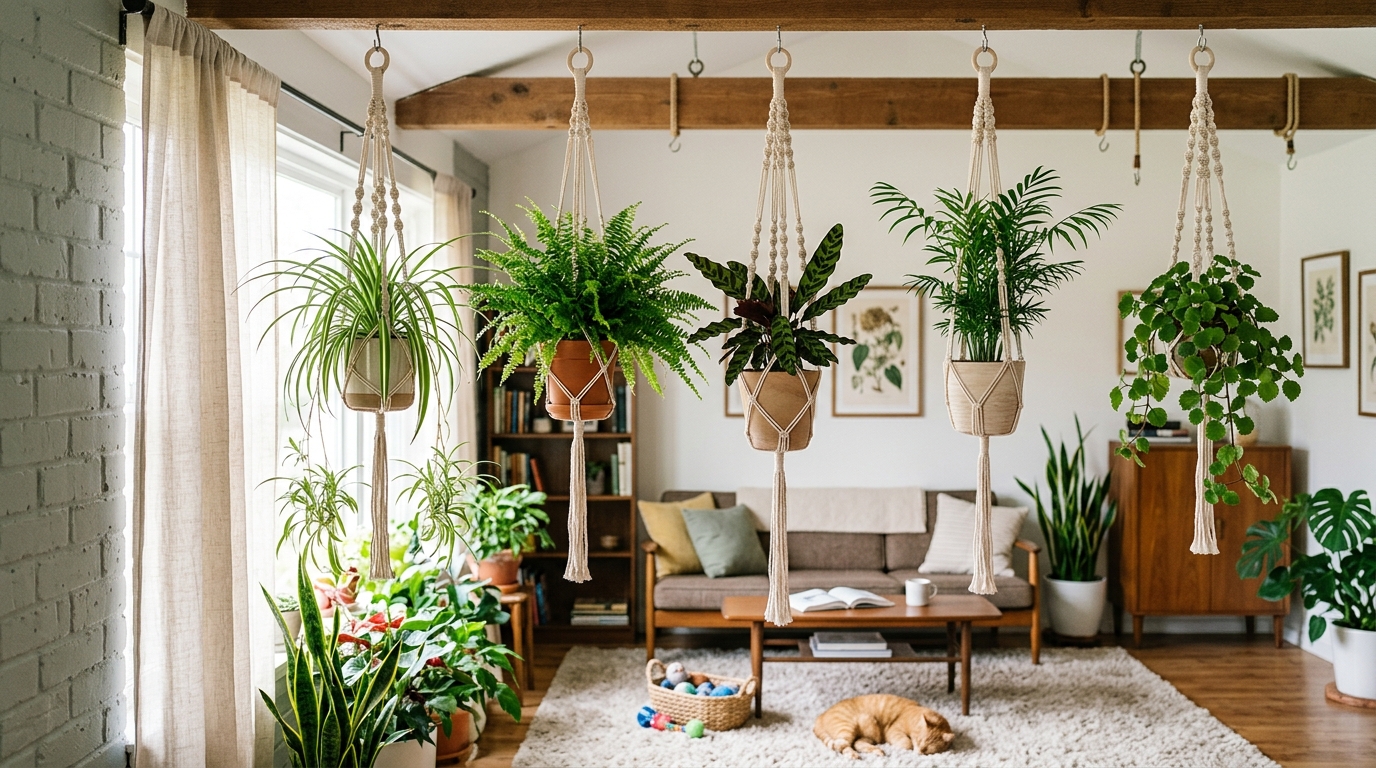
1. Golden Pothos (Epipremnum aureum)
The golden pothos is the quintessential hanging basket houseplant. Its durable heart-shaped leaves, splashed with golden-yellow variegation, cascade over container rims on flexible vines that can reach lengths of eight to ten feet indoors. Pothos tolerates fluctuating light levels, from low-light hallways to bright living rooms. Allow the top two inches of substrate to dry before watering thoroughly. When styling an entire room with reliable greenery, consult our guide to the best houseplants for every indoor living space to pair trailing pothos with complementary upright foliage.
2. Heartleaf Philodendron (Philodendron hederaceum)
Featuring delicate, bronze-tipped new leaves that mature into deep, glossy emerald hearts, the heartleaf philodendron is a graceful, low-maintenance trailing classic. It tolerates lower ambient light levels better than many variegated vines and adapts readily to dry household air. Water when the top half of the potting soil dries out, and prune trailing runners twice a year to stimulate dense branching near the crown.
3. Boston Fern (Nephrolepis exaltata ‘Bostoniensis’)
For lush, architectural volume, few suspended plants rival the Boston fern. Its arching, feathery fronds cascade outward and downward, creating a voluminous spherical display. Boston ferns thrive in bright, filtered light and demand steady moisture with high ambient humidity. They are also certified 100% non-toxic to domestic pets. If you share your home with animals, review our dedicated resource on non-toxic houseplants safe for cats to select additional pet-friendly hanging varieties.
4. English Ivy (Hedera helix)
Renowned for its lobed, maple-like leaves and clinging tendrils, English ivy creates a formal, classic aesthetic in suspended planters. It prefers cooler room temperatures (55°F to 68°F) and bright indirect light. Because ivy is susceptible to spider mites in dry winter air, rinse the foliage monthly under a gentle shower to keep leaf surfaces clean and hydrated.

5. String of Pearls (Curio rowleyanus)
For sunny windows, the string of pearls is an extraordinary succulent choice. Its slender, thread-like stems carry pea-sized spherical leaves adapted to store moisture in arid environments. A tiny epidermal “leaf window” on each bead allows sunlight to penetrate deep into photosynthetic tissue. Grow in gritty cactus soil with drainage, hang near an unobstructed south- or west-facing window, and water only when the pearls soften slightly.
6. Spider Plant (Chlorophytum comosum)
Spider plants are uniquely suited to hanging baskets because of their reproductive growth habit. As mature plants settle into containers, they send out long, arching runners carrying miniature plantlets (spiderettes) that dangle suspended in mid-air below the parent plant. They thrive in moderate to bright indirect light and tolerate irregular watering thanks to fleshy, water-storing tuberous roots.
7. Satin Pothos (Scindapsus pictus ‘Argyraeus’)
Boasting thick, velvety, matte-green leaves adorned with shimmering silver splashes, the satin pothos adds sophisticated contrast to hanging displays. Slightly slower-growing than standard pothos, Scindapsus produces compact internodes and dense, overlapping foliage. Water when the top half of the potting soil dries out; the leaves will curl inward slightly along their edges to signal thirst.
8. String of Hearts (Ceropegia woodii)
Native to South Africa, the string of hearts is a dainty, semi-succulent vine featuring delicate wire-thin purplish stems strung with small, heart-shaped leaves marbled in silver and dark green. Beneath the soil, it forms small subterranean tubers that store water, enabling it to withstand dry indoor conditions with ease. Hang in bright, filtered light and allow the potting mix to dry out almost completely between waterings.
9. Wax Plant (Hoya carnosa)
Hailing from East Asia and Australia, the wax plant produces thick, almond-shaped, waxy leaves that trail gracefully over pot edges. In spring and summer, mature hoyas produce umbels of fragrant, porcelain-like star flowers. Hoyas require bright indirect light and an airy, chunky bark-and-perlite potting mix. Water only when the top half of the soil dries, as their epiphytic roots despise waterlogged conditions.
Hanging Basket Houseplants Care Matrix
This comparative reference matrix summarizes the essential botanical requirements, hanging weight profiles, and toxicity considerations across our featured cascading houseplants.
| Plant Species | Light Requirement | Watering Frequency | Soil Mixture | Toxicity (ASPCA) |
|---|---|---|---|---|
| Golden Pothos | Low to bright indirect | Every 7–10 days (dry top 2 inches) | Standard peat-perlite blend | Toxic to dogs & cats |
| Heartleaf Philodendron | Low to medium indirect | Every 7–10 days (dry top half) | Aerated peat-perlite-bark mix | Toxic to dogs & cats |
| Boston Fern | Bright filtered indirect | Every 4–6 days (consistently moist) | Rich, moisture-retentive peat mix | Non-Toxic to pets |
| English Ivy | Medium to bright indirect | Every 6–8 days (dry top inch) | Loamy, well-draining soil | Toxic to dogs & cats |
| String of Pearls | Direct sun to bright indirect | Every 12–16 days (dry fully) | Gritty, 50% pumice/perlite cactus mix | Toxic to dogs & cats |
| Spider Plant | Medium to bright indirect | Every 7–10 days (dry top 50%) | Standard indoor potting soil | Non-Toxic to pets |
| Satin Pothos | Medium indirect shade | Every 8–12 days (dry top half) | Chunky aroid mix with bark fines | Toxic to dogs & cats |
| String of Hearts | Bright filtered indirect | Every 10–14 days (dry top 75%) | Porous succulent-perlite blend | Non-Toxic to pets |
| Wax Plant (Hoya) | Bright indirect sunlight | Every 10–14 days (dry top half) | Coarse orchid bark & perlite mix | Non-Toxic to pets |
Hardware, Potting Dynamics, and High-Elevation Watering
Maintaining hanging basket houseplants requires solving two practical mechanical hurdles: structural load support and mess-free irrigation.
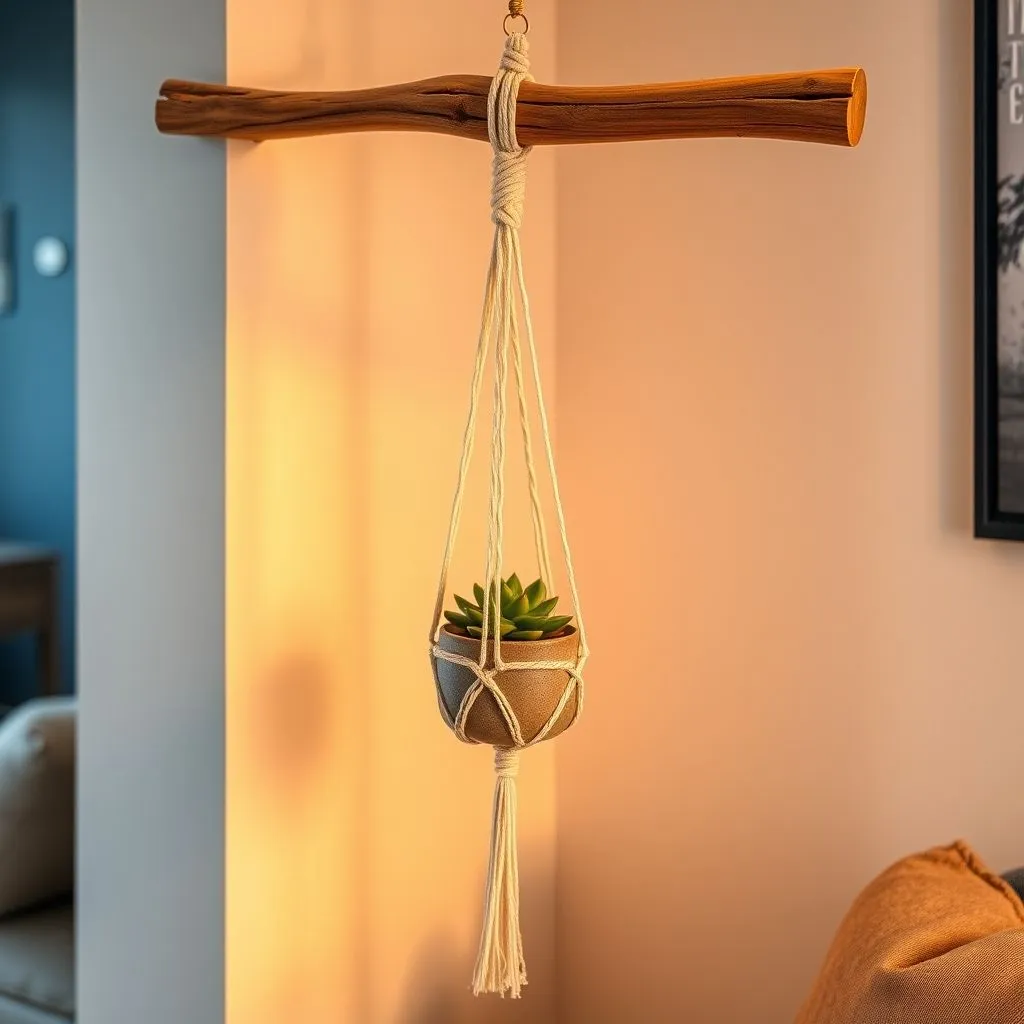
Structural Fasteners and Weight Ratings
A ten-inch hanging planter filled with moist potting substrate easily weighs between 10 and 18 pounds (4.5 to 8 kg). Never hang planters from standard drywall anchors or adhesive ceiling hooks. Always drive heavy-duty steel eye hooks directly into solid ceiling joists or wall studs. If attaching to hollow drywall is unavoidable, use spring-loaded steel toggle bolts rated for at least 30 pounds.
Preventing Water Runoff on Floors
Watering hanging planters directly in place frequently leads to dirty water dripping onto furniture and rugs below. Use containers equipped with attached drip trays, or slide plastic nursery pots into decorative, watertight cachepots. Many indoor gardeners find the simplest routine is utilizing gentle bottom watering methods: unhook the planter once a week, place it in a sink or basin filled with two inches of water for 30 minutes, let it drain completely, and hang it back up.
Pruning and Propagation for Suspended Baskets
Over time, hanging vines naturally elongate. While trailing length is visually desirable, gravity and apical dominance cause resources to concentrate at the growing vine tips, leaving upper stems sparse and thin. Regular seasonal pruning maintains a full, balanced canopy.
To prune hanging vines, use sharp, sterilized shears to snip stems just a quarter-inch below an active node. Pruning removes the terminal bud, signaling the plant to release auxins that stimulate dormant axillary buds further up the vine. This results in two or three new branches emerging where a single vine previously grew. Take your healthy trimmed cuttings, remove the lower foliage, and place the cut ends in water. Within two to three weeks, adventitious roots will emerge, providing new rooted clones that can be planted directly back into the top of the parent basket to maintain a lush, spherical appearance.
Dennis’s Advanced Troubleshooting for Hanging Baskets
Suspended plants present unique cultural challenges due to aerial thermal circulation. Drawing from my personal indoor gardening observations, here are fixes for the five most common dilemmas.
1. Bare, Balding Crown with Long Trailing Vines
What the symptom looks like: The top surface of the hanging basket becomes sparse and leafless, while the lower vines remain green and long.
Possible cause: Insufficient overhead light. When planters hang high near ceilings, the top soil surface sits above the window line in shadow, causing upper leaves to drop from light starvation.
How to identify the cause: Measure foot-candles at the top of the basket; readings below 50 foot-candles confirm upper canopy shading.
What to do: Lower the basket twelve to eighteen inches using an extended S-hook so the crown receives ambient light. Take stem cuttings from long vines, root them in water, and plant them back into the top of the pot to restore density.
How to prevent the problem: Hang baskets at or below the upper third of window frames.
2. Rapid Soil Desiccation in Suspended Pots
What the symptom looks like: The potting substrate dries out completely within 48 hours of watering, causing foliage to wilt continuously.
Possible cause: Convective heat loops near the ceiling combined with porous unglazed terracotta or breathable coir hanging liners.
How to identify the cause: The pot feels feather-light two days after a thorough soak.
What to do: Slip a plastic pot liner inside decorative macrame or coir baskets to slow down evaporation. Incorporate water-retentive coco coir or vermiculite into the soil mix.
How to prevent the problem: Use glazed ceramic or plastic nursery pots inside hanging holders.
3. Snapped Stems from Excessive Weight or Bumping
What the symptom looks like: Heavy, mature trailing vines fracture or snap near the container rim, especially after watering.
Possible cause: Sharp container edges pressing against turgid stems, or baskets hung in high-traffic pathways where people bump into them.
How to identify the cause: Stems show clean pinch marks or fractures right at the pot’s rim.
What to do: Trim snapped stems cleanly with scissors and propagate them in water. Smooth sharp plastic pot rims with sandpaper or pad them with soft foam tape.
How to prevent the problem: Position hanging baskets in corners away from door swings and walking paths.
4. Water Repelling and Channeling Down Pot Edges
What the symptom looks like: Water poured into the top immediately rushes down the inside wall of the container and drains out without soaking the center.
Possible cause: Hydrophobic soil shrinkage. When peat-based soil dries out thoroughly, the root ball shrinks away from the pot wall, creating open channels.
How to identify the cause: Observe water draining instantly from the bottom while the root ball floats or remains bone-dry.
What to do: Take down the basket and submerge it in a bucket of water for 45 minutes to rehydrate the peat core completely.
How to prevent the problem: Never allow peat-based hanging pots to dry out into hard, shrunken blocks.
5. Mite Outbreaks on Trailing Foliage
What the symptom looks like: Fine silken webbing appears between hanging leaf petioles, accompanied by dusty, stippled yellow leaves.
Possible cause: Two-spotted spider mites thriving in warm, stagnant air near the ceiling. Extension guides from the University of Minnesota Extension on hanging houseplants note that suspended containers are disproportionately vulnerable to mites during winter heating cycles.
How to identify the cause: Tap trailing vines over white paper to detect moving microscopic specks.
What to do: Carry the basket to a bathtub and wash the entire plant thoroughly with a handheld shower sprayer. Treat with insecticidal soap every five days for three weeks.
How to prevent the problem: Maintain room humidity above 50% and spray foliage occasionally with room-temperature water.
Seasonal Care and Maintenance Cycles
Adapting your hanging plant care routine to natural seasonal shifts ensures steady trailing growth year-round.
Spring and Summer Expansion
From April through August, longer daylight hours and active photosynthesis drive rapid vine elongation. Check hanging baskets twice a week, as warm ceiling air accelerates moisture consumption. Apply a balanced liquid organic fertilizer diluted to one-quarter strength every four weeks. Pinch back vine tips regularly to stimulate dense lateral shoots and keep the crown full.
Autumn and Winter Management
Between November and February, home heating systems create dry, hot air currents near ceilings. Lower hanging baskets by twelve inches to reduce heat stress, and move them closer to south-facing windows to capture scarce winter sunlight. Reduce watering frequency by 40%, and cease all fertilization until active growth resumes in spring.
Master FAQ: Hanging Baskets Indoors
How do I water indoor hanging baskets without making a mess on the floor?
The cleanest and most reliable method for watering indoor hanging baskets is the take-down bottom-watering technique. Once a week, unhook your hanging planters and carry them to a sink, bathtub, or utility tub filled with two to three inches of lukewarm water. Allow the pots to soak from the bottom for 30 to 45 minutes, drawing moisture deep into the root ball through capillary action. Lift the pots, allow all excess water to drain out of the drainage holes for ten minutes, wipe the container bases, and hang them back up. Alternatively, use hanging planters with deep, securely attached snap-on saucers or water reservoirs that catch runoff directly.
Why is the top of my hanging basket going bald while the vines are long?
A balding crown is almost always caused by inadequate overhead lighting. When hanging baskets are mounted high on ceiling hooks, the upper rim of the container frequently sits above the window line, placing the top soil surface in a deep shadow blind spot. The trailing vines continue growing because they dangle down into the light stream, but the shaded leaves at the crown gradually starve, turn yellow, and drop off. To fix this, lower your hanging basket 12 to 18 inches using an S-hook or extension chain so natural light reaches the top of the pot. Propagate trimmed vine cuttings and plant them into the top soil to restore dense foliage.
What type of pot is best suited for hanging basket houseplants indoors?
The best pots for indoor hanging baskets are lightweight plastic nursery containers fitted with drainage holes and nestled inside decorative hanging cachepots, or specialized planters with integrated overflow reservoirs. While traditional outdoor hanging baskets often use open coco coir fiber liners, these dry out far too quickly in dry residential heating air and leak water onto floors when irrigated. Lightweight plastic or resin planters retain moisture evenly, reduce the physical load on ceiling anchors, and prevent water damage to your home interior. Ensure whatever container you choose has functional drainage outlets to prevent root rot.
How do I securely install heavy hanging plants into drywall ceilings?
Securely installing hanging plants requires matching your hardware to the structure above your ceiling. The safest approach is locating a solid wooden ceiling joist using an electronic stud finder and screwing a heavy-duty, threaded steel eye hook directly into the solid timber to a depth of at least two inches. If hanging in a location where no joist exists, never use plastic screw-in drywall anchors; instead, install a heavy-duty spring-wing toggle bolt rated for at least 30 to 50 pounds. Drill a hole through the drywall, insert the collapsed toggle bolt wings, tighten the hook flush against the ceiling, and test the hook with firm downward pressure before hanging the plant.
How often should I trim trailing vines on hanging houseplants?
You should trim trailing vines on hanging houseplants once or twice a year, ideally during active vegetative growth in spring and early summer. Trimming prevents vines from becoming excessively heavy, avoids contact with heaters or pets, and triggers botanical branching. When you pinch or snip a trailing stem just above a leaf node, you remove the plant’s apical dominance, which stimulates dormant axillary buds further up the stem to produce fresh, bushy lateral growth. Save your trimmed stem cuttings: remove the bottom two leaves, place the stems in a jar of clean water, and within three weeks you will have rooted plantlets ready to pot.
Do hanging plants need more fertilizer than floor-standing houseplants?
No, hanging plants do not require more fertilizer than floor plants; in fact, they often require slightly lighter feeding. Because warm air near ceilings accelerates soil evaporation, water is absorbed quickly, leaving unused mineral fertilizer salts concentrated in the root ball. Excess fertilizer salts can desiccate root tips, causing brown foliar margins and scorched leaf tips. Apply a balanced liquid organic houseplant fertilizer diluted to one-quarter of the standard strength once a month from April through August. Always apply fertilizer to moist soil rather than bone-dry substrate to protect sensitive root hairs from chemical burn.
How do I know if my hanging plant is getting too heavy for its ceiling hook?
Evaluating the mechanical safety of a suspended planter requires observing the mounting hardware and surrounding ceiling plaster. Signs of structural strain include hairline cracks forming in the drywall around the ceiling hook, the hook pulling away or sagging downward, or the anchor loosening when touched. Remember that a hanging basket weighs significantly more immediately after watering than when dry. To prevent unexpected failures, weigh your potted plant on a bathroom scale while fully saturated with water. Ensure your ceiling hook and anchor system are rated for at least double the plant’s maximum wet weight.
Dennis P. Hansen
Dennis P. Hansen is a home gardener with a genuine passion for plants and the simple pleasure of growing them. He enjoys caring for houseplants, succulents, and other plants at home while continually learning from everyday gardening experiences. Dennis likes to share practical plant care tips, useful observations, and simple solutions that can help others grow healthier plants. He believes that caring for plants is a rewarding journey and that there is always something new to learn along the way.